
You have tried the serums. You have done the research. You have watched the routines on TikTok and followed the before-and-afters and bought the products that seemed to work for everyone else.
And your skin is still not where you want it to be.
Here is what I want you to hear before we go any further: the problem is almost certainly not your skin.
It is the system, or more accurately, the absence of one. Because the skincare industry is very good at selling products, and not particularly interested in helping you understand why none of them are working.
These seven mistakes are what I see most often. And the good news is that every single one has a concrete fix, usually something you stop doing, not something else you need to buy.
Mistake 1 -> Switching products before they have had time to work
This is the one that silently ruins more routines than anything else.
Skin renews itself in a 28-day cycle. New cells produced at the base of the skin take four weeks to reach the surface. Most products need at least one full cycle — and often two — before you can reasonably assess whether they are working.
The instinct to switch at week two is completely understandable. Nothing seems to be happening. Something new just came out. The person you follow online is raving about a different serum. So you swap, and the clock resets.
After months of this, you have a drawer full of products you have never really given a chance. And no idea what works for your skin, because nothing has ever been in your routine long enough to find out.
The fix: Pick a routine and commit to it for eight weeks. Set a reminder in your calendar. Do not change anything — not the cleanser, not the moisturizer, not the treatment — until that date. After eight weeks, you will have actual information. Before that, you are just guessing.
Mistake 2 -> Using too many active ingredients at once
The logic makes sense on paper: if vitamin C brightens, and retinol resurfaces, and a BHA exfoliates, and niacinamide calms, using all four together should do all four things at once.
What actually happens is different. The skin barrier has a tolerance threshold. Push past it and it stops functioning well. You get the opposite of everything you were aiming for redness, sensitivity, increased breakouts, and a barrier that is too disrupted to absorb anything properly.
Signs you have gone past that threshold: your skin stings when you apply your moisturizer. It looks perpetually flushed. Breakouts are appearing in new places. Products that felt fine before now feel irritating. These are not your skin adjusting. They are your skin asking you to stop.
The fix: One active at a time. Start with your most important concern and choose one product to address it. Give it eight weeks. Only then — if the basics are stable and your barrier feels healthy — consider whether you actually need to add anything else. Most people find they do not.
Mistake 3 -> Cleansing too aggressively
Squeaky clean feels right. It feels thorough. It feels like you have done something.
But that tight, stripped feeling after washing is not clean skin — it is a disrupted acid mantle. The acid mantle is the skin’s natural protective layer, a slightly acidic film that keeps bacteria out and moisture in. Harsh cleansers — especially those with high-foaming sulfates — strip it every time you wash.
For oily skin, stripping triggers a compensation response: the skin produces more oil to make up for what was lost. You end up oilier than you started. For dry or sensitive skin, stripping depletes the barrier, leading to tightness, flaking, and increased reactivity.
Neither outcome is your skin being difficult. It is your skin responding rationally to the wrong cleanser.
The fix: Find a cleanser that leaves your skin feeling comfortable immediately after rinsing — not tight, not greasy, just neutral and calm. For oily skin, a gentle gel formula. For dry or sensitive skin, a cream or milk cleanser. If you are not sure, err toward gentler. In the evening, make sure you cleanse thoroughly enough to remove sunscreen — but with a product that respects the barrier, not one that wages war on it.
Mistake 4 -> Skipping SPF
This one is worth being direct about.
80% of visible skin aging — the lines, the pigmentation, the loss of elasticity — is caused by UV radiation. Not time. UV. And UVA rays, the ones responsible for aging, penetrate cloud cover and glass. They come through your car window on the commute. They reach you through the window of the room you are sitting in right now.
Every day you skip SPF is a day of UV exposure without protection. Compounded over months and years, this accumulates visibly in the skin.
SPF also makes every other step in your routine work harder. You can use the best vitamin C serum available, but without daily sun protection, you are partially undoing the brightening work every time you step outside.
The fix: SPF 30 or higher, broad-spectrum, every morning — the last step before you leave the bathroom. It does not matter whether it is sunny. It matters whether you are near a window or outside. The right formula makes this easy to do every day. If you find SPF uncomfortable, the problem is usually the formula, not the concept. Try mineral formulas (zinc oxide or titanium dioxide) if you have sensitive skin. Try lightweight chemical formulas if your skin is oily.
Mistake 5 -> Choosing products based on what worked for someone else
This is how TikTok sells skincare. Before-and-after content is compelling, and it is supposed to be. A product that cleared someone’s acne, brightened someone’s tone, or transformed someone’s texture looks like the answer you have been looking for.
But their skin type, lifestyle, climate, age, and existing routine are all variables you cannot see in a 30-second clip. A product that performs brilliantly on oily, acne-prone skin can actively worsen dry, sensitive skin. The ingredient that transformed someone’s texture at 22 can be too irritating for someone’s skin at 42.
This is not about the product being good or bad. It is about fit. And fit is personal.
The fix: Choose products based on your skin type and your specific concern — not on results someone else got. When you know what your skin actually needs (dry, oily, sensitive, combination — and what you are trying to address), the decision becomes much simpler. You are looking for fit, not buzz.
Mistake 6 -> Expecting results in days instead of weeks
Social media has trained a very particular expectation: ten days to transformation. Two weeks to clear skin. Visible glow by the weekend.
This is not how skin biology works, and the gap between expectation and reality causes more people to abandon effective routines than any other factor.
Meaningful change to your skin’s texture, tone, and clarity takes 8–12 weeks of consistency. This aligns with the skin’s renewal cycle — new cells formed today will not be visible on the surface for four weeks. A routine started today cannot reasonably be assessed before week six or eight.
Retinol takes even longer — twelve weeks for meaningful results, and the first few weeks often bring purging (a temporary increase in breakouts as cell turnover accelerates). Most people stop using it during that window, right before it would have started working.
The fix: Set your expectations accurately before you start. Write down how your skin looks and feels today. Look again at eight weeks. The change is rarely dramatic from day to day — but it becomes unmistakable when you compare a two-month gap. The problem is that most people never get to two months with the same routine.
Mistake 7 -> Spending money on the wrong things
Most skincare spending goes to the wrong products.
Expensive cleansers are one of the most common misallocations — a cleanser sits on your skin for thirty seconds before you rinse it off. The formula barely has time to interact with your skin. A gentle, pH-balanced cleanser at any price point does the same job as a luxury one.
Where quality matters more: products that stay on your skin. Your moisturizer, your SPF, your treatment serums — these have time to actually penetrate and do something. This is where it is worth spending more, if you are going to.
The other common misallocation is variety. Ten moderately priced products used inconsistently will never outperform three good ones used every single day.
The fix: Spend less on cleanser. Spend appropriately on moisturizer and SPF. Choose one targeted treatment rather than several competing ones. And measure value not by price but by how consistently you actually use it. A product that sits unused is infinitely less valuable than one you reach for every morning and evening without thinking.
The reset, if nothing is working
If you read this list and recognized your routine in several of these mistakes, the most effective thing you can do is start over, but in the simplest possible way.
Tonight: remove everything from your active routine except a gentle cleanser and a moisturizer. Set them on the counter. Everything else goes in a drawer.
This week: cleanse and moisturize, morning and evening. Nothing else. Let your barrier recover.
After one week of that: add SPF back in for the morning.
After four weeks of that foundation being stable: consider — and this is genuinely optional — whether you have one specific concern you want to address. If yes, choose one product for that concern. Add it in the evening. Give it eight weeks.
That is the reset. It is not exciting. But the women who follow it are the ones who stop cycling through products and start actually seeing change.
Your skin is not the problem. Your system probably was.
Now you have one.
Frequently Asked Questions
The most common reasons: switching products before giving them 6–8 weeks to work, using too many active ingredients at once, skipping SPF daily, and cleansing too aggressively. The fix is almost always to strip back, not to add more.
If your skin is reacting with breakouts, redness, or sensitivity after starting a new routine, overloading is often the cause. A healthy routine is a cleanser, moisturizer, SPF, and one targeted treatment. Anything beyond that should be introduced slowly, one product at a time.
Two likely causes: purging — retinol and acids can cause a temporary increase in breakouts as skin cell turnover accelerates, typically resolving within 4–6 weeks — or barrier disruption from too many actives introduced too fast. Strip back to basics and give skin time to recover.
Look for skin that feels comfortable after your routine at week one, improved texture at weeks 4–6, and visible change in your main concern at weeks 8–12. If you have not changed anything in 8 weeks and see zero improvement, then reassess. If you keep switching before 8 weeks, you cannot know.
Expensive cleansers (they wash off — quality matters less), most toners for beginners, eye creams when a good moisturizer applied carefully does the same job, sheet masks as a routine substitute, and any product built around a trend ingredient without clinical backing.
Yes. Stacking too many active ingredients — especially exfoliating acids, vitamin C, and retinol together — can overwhelm and damage the skin barrier. A damaged barrier causes the exact problems you are trying to fix: breakouts, redness, sensitivity, and dullness.
A minimum of 6–8 weeks for most products. Retinol needs 12 weeks. Exception: if a product causes immediate stinging or worsening breakouts in the first 1–2 weeks, stop — that is a reaction, not adjustment.
Free Guide
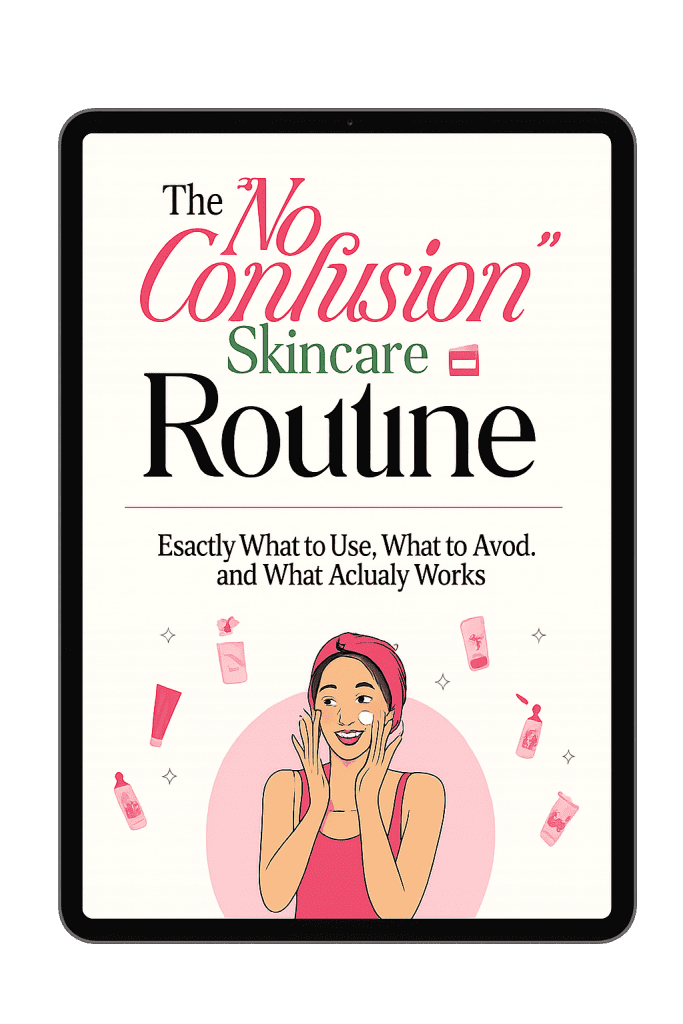
The “No Confusion” Skincare Routine: Exactly What to Use, What to Avoid, and What Actually Works
Get a simple, step-by-step routine you can follow immediately so you stop guessing, stop wasting money, and finally feel clear and confident in your skincare.