Our method
How we score an ingredient
Every verdict on this site is built the same way, from the same data, with no thumb on the scale. Here is exactly how, so you can trust what you read and check my work.
Where the data comes from
Behind every glossary page sits a curated ingredient knowledge base: a structured file where each ingredient carries the same set of fields, assembled from dermatology literature and cosmetic-chemistry references rather than from brand marketing. The molecular structure diagrams come from PubChem, the public database run by the US National Institutes of Health, which is in the public domain. Nothing here is drawn or invented by a machine pretending to be a chemist. Every ingredient carries the same fields, filled in the same way, and the knowledge base is reviewed and dated so you can see how fresh it is. When new research lands, the entry gets updated, not quietly rewritten to suit a trend.
What the 0 to 10 scores mean
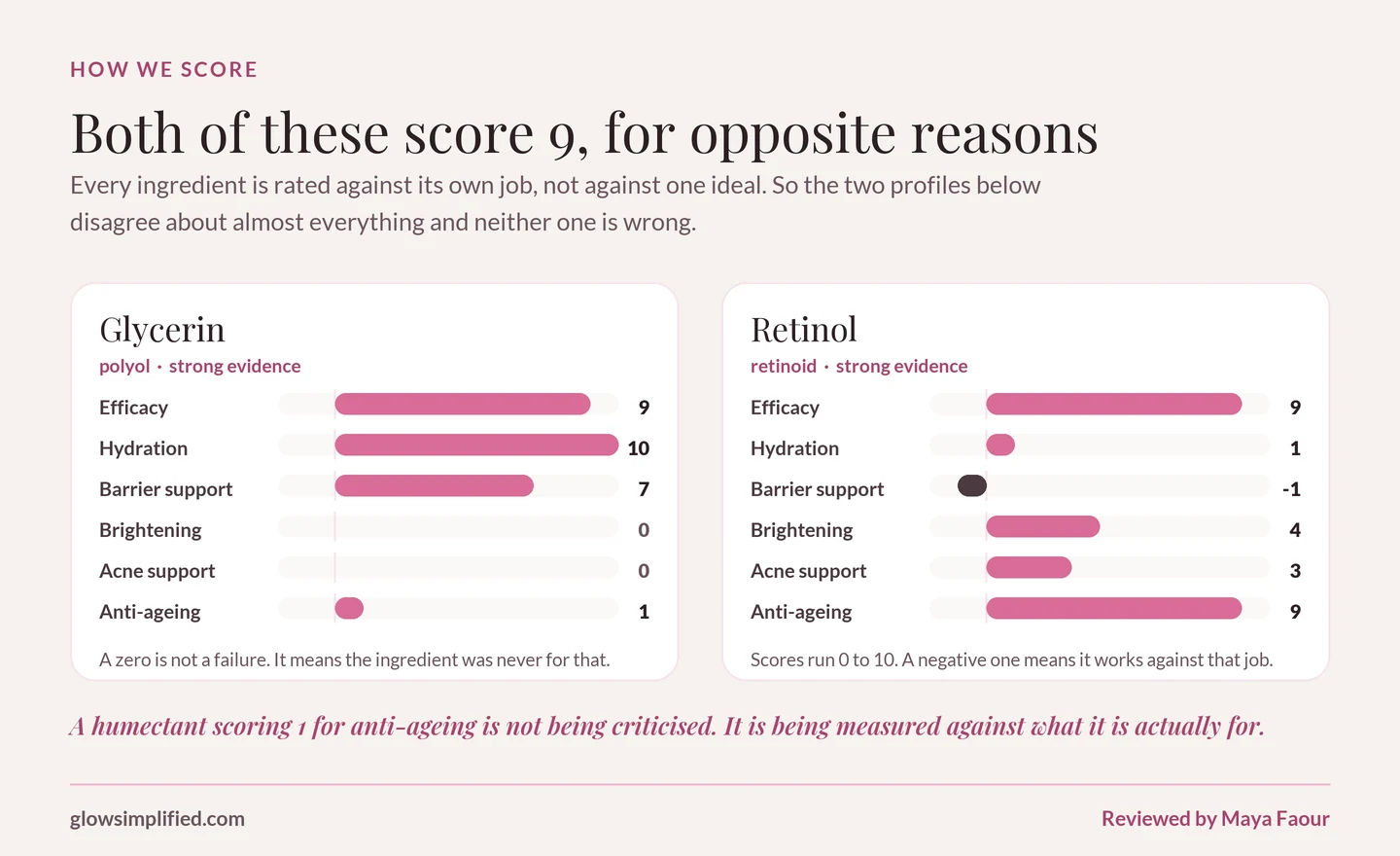
Each ingredient is scored on a few dimensions: efficacy, hydration, barrier support, brightening, acne support, and anti-aging. A score is judged against the ingredient's real job, not against some universal ideal. A humectant is rated on how well it hydrates, not scolded for failing to fight wrinkles it was never meant to touch. So a high hydration score and a low anti-aging score on the same ingredient is not a contradiction, it is the honest picture. A sunscreen filter is judged on protection, a cleanser on how kindly it cleans. The number is a shorthand for how well an ingredient does its own job, nothing more.
What the evidence levels mean
Scores are only half the story. Each ingredient also carries an evidence level: strong, moderate, emerging, or weak. Strong means large, repeated human studies. Moderate means real support with some gaps. Emerging means early and interesting, but not proven. Weak means the claims run ahead of the proof. When a study is small, or done in a dish rather than on skin, I say so, and the level reflects it. A popular ingredient with thin evidence gets called exactly that.
How the verdict is decided
The one-line verdict at the top of each page is not written by hand, ingredient by ingredient. It is produced by a fixed set of rules that run the same way for every entry: the scores and the evidence go in, the verdict comes out. That means the retinol page and the snail-mucin page are held to identical standards, and nobody's product earns a kinder sentence. There are no sponsorships behind these pages, and no affiliate links sitting inside the glossary, the checker, or the comparisons. If that ever changes, it will be labelled plainly. Because the logic is fixed rather than hand-written, the same inputs always give the same verdict, and you could work out why a page says what it says.
What we do not claim
This is education, not a diagnosis. The pages tell you what an ingredient tends to do and who tends to react to it, in general. They are not medical advice, and they are not a substitute for patch testing a new product on your own skin, or for a dermatologist who can actually see your face. If you are pregnant, managing a skin condition, or reacting to something, a real professional beats any chart, including mine.
Why products get no overall score
Ingredients get numbers here. Finished products do not, and that was a decision rather than an omission. We built a product rating twice, wrote down what would count as success before running either version, and both times the result told us to stop. The first scored safety and came out flat, because almost everything we cover is already fragrance free. The second scored value, passed every number we had set, and then produced an ordering we could not explain in a sentence. The whole record is here, including the two tests, what the rating apps get wrong, and the widget that lets you move the constant yourself and watch the ranking follow you.
The goal is simple: give you the honest version, the same way every time, and never make you take my word for it.
— Maya
Scoring engine and tools built by Sasu Dan Liviu.
Corrections and updates
Nothing has been corrected on this page since it was published. If that changes, the change will be listed here with its date rather than quietly edited in.
Last re-read against its sources on . If you find an error, tell us and we will fix it and say so.
Get the next one
We read the primary papers, write to the researchers, and print what they say. If that is useful, the free plain-words routine guide comes with it. No spam, and nothing sold here.