
Ingredient pairing
Can you mix Lactic acid and Retinol?
Same answer whichever way you searched it: Retinol and Lactic acid.
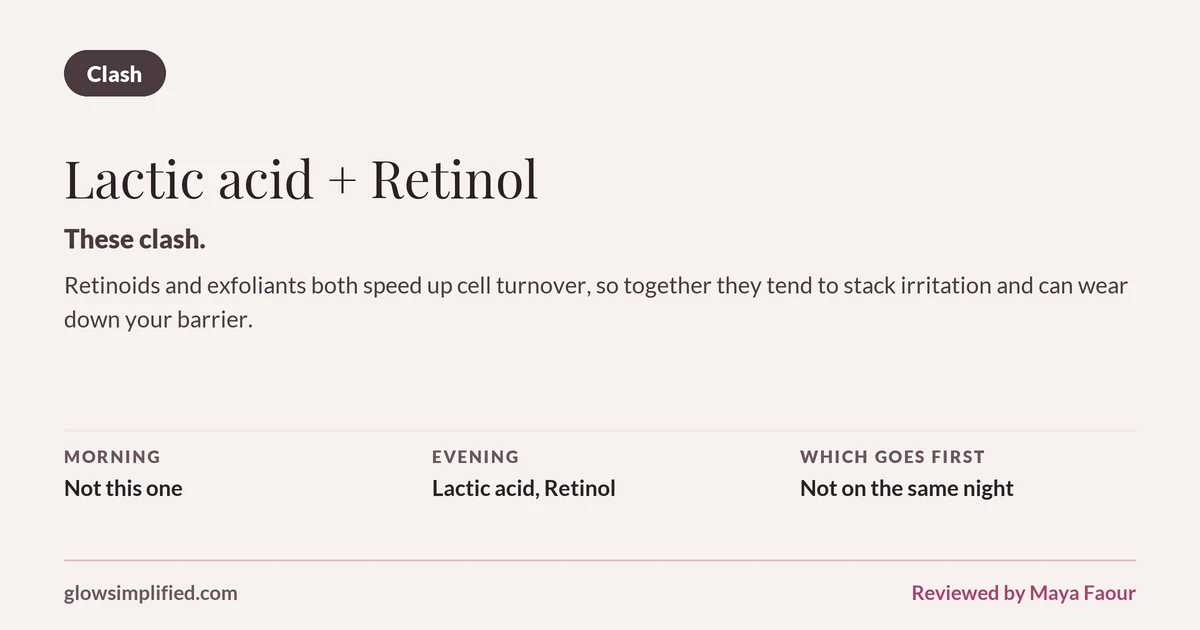
ClashThese clash.
Retinoids and exfoliants both speed up cell turnover, so together they tend to stack irritation and can wear down your barrier.
Do this: Use them on alternate nights rather than the same evening.
☀ Morning
Nothing here☾ Evening
Lactic acidRetinolLactic acid makes skin more vulnerable to UV.Use on alternate nights, not the same evening.
Skip if: very sensitive, compromised barrier
Ask your doctor in pregnancySkip if: pregnancy, breastfeeding, very sensitive, compromised barrier
Not in pregnancyWhich one goes first?
Not on the same night
Use Lactic acid and Retinol on alternate evenings rather than layering them together.
How to introduce Lactic acid and Retinol
- Patch test each one first: a coin-sized amount on your inner forearm for two or three days, watching for redness or stinging.
- Alternate nights: Lactic acid one evening, Retinol the next, so your skin only handles one of them at a time.
- Ease the retinoid in slowly: start at two nights a week for the first fortnight, then build up only as your skin stays comfortable.
- If skin turns tight, flaky, red or starts to sting, drop back a step and let your barrier recover for a few days before pushing on again.
Two strong actives at once is a lot to ask of your skin. Going slow is exactly what keeps this pairing working instead of backfiring.
For your skin type If your skin is sensitive or reactive, take this pair slowly: Retinol is the higher-irritation ingredient here, and using actives close together magnifies that. On the upside, Lactic acid leans hydrating or soothing, which helps buffer the rest.
Choosing between them instead? Lactic acid vs Retinol →
Also worth checking
More pairings with Lactic acid
More pairings with Retinol
Lactic acid and Retinol, answered
Can you mix Lactic acid and Retinol?
These clash. Retinoids and exfoliants both speed up cell turnover, so together they tend to stack irritation and can wear down your barrier. Use them on alternate nights rather than the same evening.
Should you use Lactic acid and Retinol in the morning or at night?
Keep them to the evening, but on alternate nights rather than together.
How should you introduce Lactic acid and Retinol?
Patch test each one first: a coin-sized amount on your inner forearm for two or three days, watching for redness or stinging. Alternate nights: Lactic acid one evening, Retinol the next, so your skin only handles one of them at a time. Ease the retinoid in slowly: start at two nights a week for the first fortnight, then build up only as your skin stays comfortable. If skin turns tight, flaky, red or starts to sting, drop back a step and let your barrier recover for a few days before pushing on again. Two strong actives at once is a lot to ask of your skin. Going slow is exactly what keeps this pairing working instead of backfiring.
What else should you not mix with Lactic acid?
Lactic acid is best kept apart from Retinal, Hydroxypinacolone Retinoate, Retinyl Palmitate, Retinyl Acetate. Introduce any new active one at a time.
Sources
- Mukherjee et al., "Retinoids in the treatment of skin aging" (Clinical Interventions in Aging, 2006)
- Kornhauser et al., "Applications of hydroxy acids" (Clinical, Cosmetic and Investigational Dermatology, 2010)
Plus how we reach every verdict: how we score →
General guidance, not medical advice. When in doubt, introduce one product at a time, andhere is when to see a dermatologist instead.