
How skincare works
Does any of this actually get in?
Mostly no. And mostly, it does not need to. Here is the size rule the industry quotes when it suits them, applied to 127 ingredients including the ones that fail it.
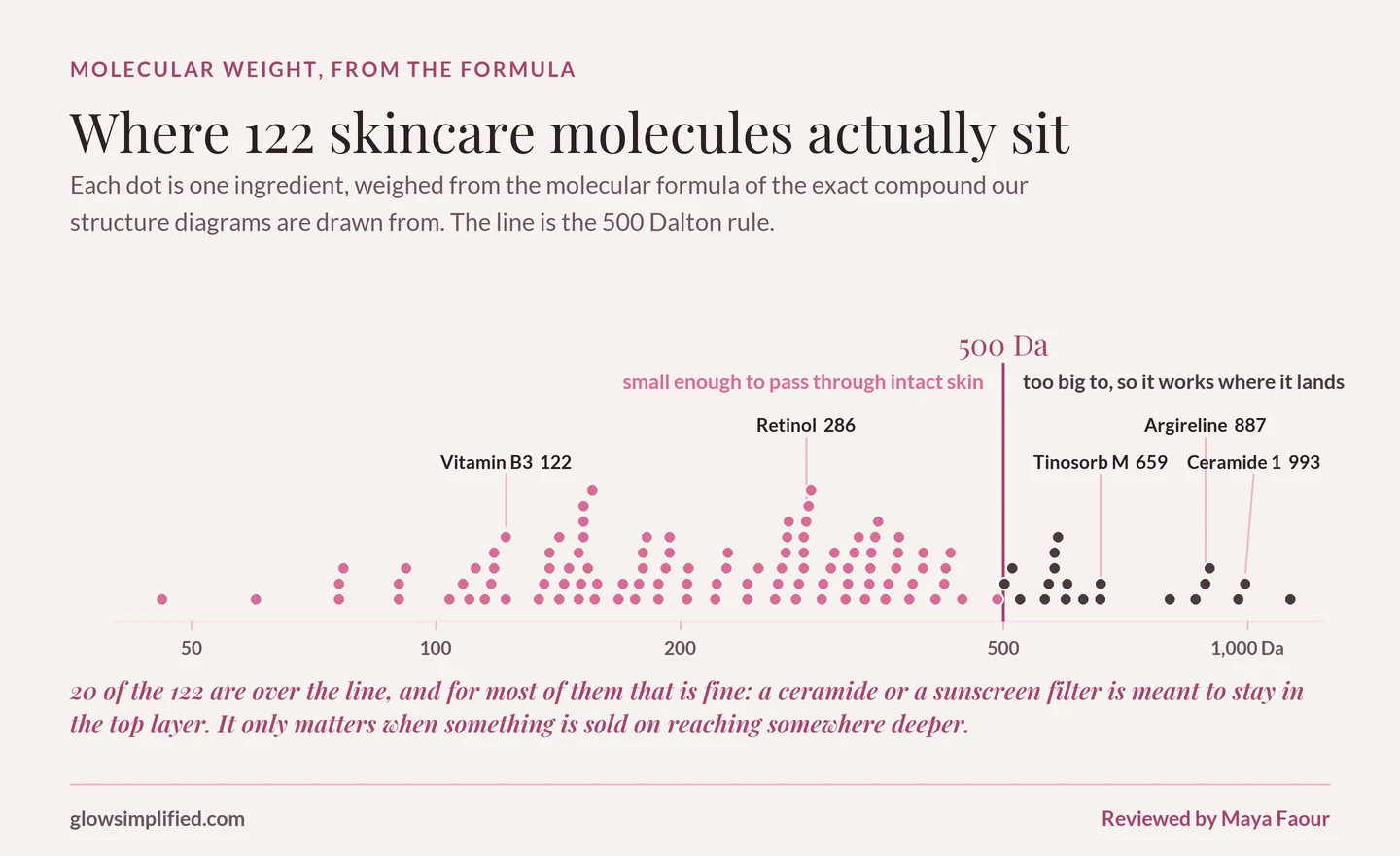
A molecule generally has to weigh less than about 500 daltons to cross intact skin unaided. Of the 127 skincare ingredients we hold a verified molecular weight for, 20 are above that line. For 9 of them that changes nothing, because their job was always to stay on the surface. For the other 11, it is a fair question, because they are sold on going deep.
Most of your routine works in the top 20 microns
The outermost layer of skin, the stratum corneum, is about 10 to 20 micrometres thick. That is roughly a fifth of the width of a human hair, and it is made of cells that are already dead. It is also where 89 of the 200 ingredients in our glossary do their work: every humectant, every emollient, every exfoliant, every barrier lipid.
This is not a disappointment. A moisturiser that reached your bloodstream would be a drug with a side-effect profile, not a moisturiser. The reason to know where something works is not to be impressed by depth, it is to spot when a product is charging you for a journey it never makes.
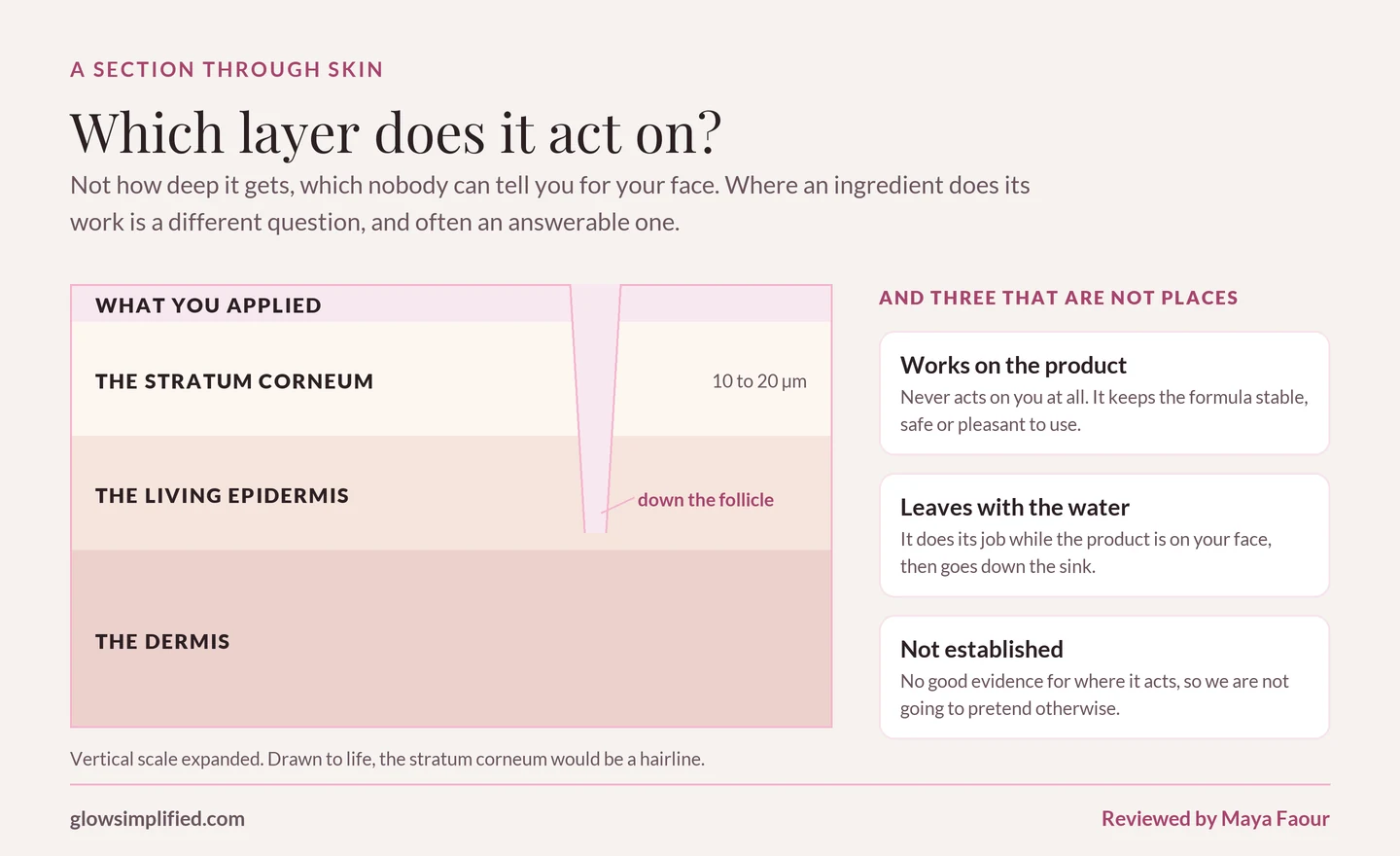
Works on the product
This one never acts on you at all. It keeps the formula stable, safe or pleasant to use.
Phenoxyethanol, Methylisothiazolinone, Denatured Alcohol and 15 more
Leaves with the water
It does its job while the product is on your face, then goes down the sink.
Sodium Lauryl Sulfate, Sodium Laureth Sulfate, Cocamidopropyl Betaine and 4 more
On top of the skin
It works as a film sitting on the surface. Staying there is the point, not a shortfall.
Tinosorb S, Zinc Oxide, Avobenzone and 17 more
The stratum corneum
The dead outer layer: flat cells packed in a lipid mortar. Most skincare works here.
Salicylic acid (BHA), Ceramide 3, Hyaluronic acid and 86 more
Down the follicle
The pore is a channel through the layers above, which is how some ingredients get past them.
The living epidermis
Below the dead layer: the cells that are still alive, including the ones that make pigment.
Vitamin B3, Retinol, Retinal and 16 more
The dermis
Deeper still, where collagen and elastin sit. Very little applied to skin reliably gets here.
Not established
We could not find good evidence for where this one acts, so we are not going to pretend.
THD Ascorbate, Bakuchiol, Ethyl Ascorbic Acid and 40 more
Every weight we can verify, heaviest first
127 ingredients, each weight computed from the molecular formula of the same compound our structure diagrams are drawn from. Nothing here is estimated. The ones missing from this table are missing for a reason: plant oils, extracts, ferments and polymers are mixtures, so there is no single molecule to weigh. Hyaluronic acid and collagen are both in that group.
| Ingredient | Formula | Daltons | Works on |
|---|---|---|---|
| THD Ascorbate | C70H128O10 | 1130 | Not established |
| Ceramide 1 | C63H125NO6 | 993 | The stratum corneum |
| Madecassoside | C48H78O20 | 975 | Not established |
| Dipotassium Glycyrrhizate | C42H60K2O16 | 899 | Not established |
| Argireline | C35H62N14O11S | 887 | Not established |
| Coenzyme Q10 | C59H90O4 | 863 | Not established |
| Palmitoyl Pentapeptide-4 | C39H75N7O10 | 802 | Not established |
| Phytic Acid | C6H18O24P6 | 660 | The stratum corneum |
| Tinosorb M | C41H50N6O2 | 659 | On top of the skin |
| Tinosorb S | C38H49N3O5 | 628 | On top of the skin |
| Ceramide 6-II | C36H73NO5 | 600 | The stratum corneum |
| Astaxanthin | C40H52O4 | 597 | Not established |
| Ceramide 3 | C36H73NO4 | 584 | The stratum corneum |
| Magnesium Ascorbyl Phosphate | C12H12Mg3O18P2 | 579 | Not established |
| Palmitoyl Tripeptide-1 | C30H54N6O5 | 579 | Not established |
| Retinyl Retinoate | C40H56O2 | 569 | The living epidermis |
| Mexoryl SX | C28H34O8S2 | 563 | On top of the skin |
| Retinyl Palmitate | C36H60O2 | 525 | The living epidermis |
| Cetearyl Alcohol | C34H72O2 | 513 | The stratum corneum |
| Mexoryl XL | C24H39N3O3Si3 | 502 | On top of the skin |
| 500 daltons: below here, a molecule can generally cross intact skin on its own | |||
| Acetyl Tetrapeptide-5 | C20H28N8O7 | 492 | Not established |
| Behentrimonium Methosulfate | C26H57NO4S | 480 | The stratum corneum |
| Cyclohexasiloxane | C12H36O6Si6 | 445 | The stratum corneum |
| Vitamin E | C29H50O2 | 431 | The stratum corneum |
| Myristyl Myristate | C28H56O2 | 425 | The stratum corneum |
| Squalane | C30H62 | 423 | The stratum corneum |
| Adapalene | C28H28O3 | 413 | The living epidermis |
| Hydroxypinacolone Retinoate | C26H38O3 | 399 | The living epidermis |
| Uvinul A Plus | C24H31NO4 | 398 | On top of the skin |
| Cholesterol | C27H46O | 387 | The stratum corneum |
| Cetearyl Isononanoate | C25H50O2 | 383 | The stratum corneum |
| Glyceryl Stearate | C21H44O5 | 377 | Not established |
| Tetrahydrocurcumin | C21H24O6 | 372 | Not established |
| Cyclopentasiloxane | C10H30O5Si5 | 371 | The stratum corneum |
| Cetyl Ethylhexanoate | C24H48O2 | 369 | The stratum corneum |
| Sodium Lauroyl Lactylate | C18H31NaO6 | 366 | Leaves with the water |
| Octocrylene | C24H27NO2 | 361 | On top of the skin |
| Lactobionic Acid | C12H22O12 | 358 | The stratum corneum |
| Tazarotene | C21H21NO2S | 351 | The living epidermis |
| Coco-Glucoside | C18H36O6 | 348 | Leaves with the water |
| Maltitol | C12H24O11 | 344 | The stratum corneum |
| Retinyl Propionate | C23H34O2 | 343 | The living epidermis |
| Trehalose | C12H22O11 | 342 | The stratum corneum |
| Ascorbyl Glucoside | C12H18O11 | 338 | Not established |
| Disodium EDTA | C10H14N2Na2O8 | 336 | Not established |
| Sodium Laureth Sulfate | C14H29NaO5S | 332 | Leaves with the water |
| Retinyl Acetate | C22H32O2 | 328 | The living epidermis |
| Sodium Ascorbyl Phosphate | C6H6Na3O9P | 322 | Not established |
| Zinc PCA | C10H12N2O6Zn | 322 | Not established |
| Decyl Glucoside | C16H32O6 | 320 | Leaves with the water |
| Phytosphingosine | C18H39NO3 | 318 | Not established |
| Avobenzone | C20H22O3 | 310 | On top of the skin |
| Glutathione | C10H17N3O6S | 307 | Not established |
| Tretinoin | C20H28O2 | 300 | The living epidermis |
| Isopropyl Palmitate | C19H38O2 | 299 | The stratum corneum |
| Octinoxate | C18H26O3 | 290 | On top of the skin |
| Sodium Lauryl Sulfate | C12H25NaO4S | 288 | Leaves with the water |
| Retinol | C20H30O | 286 | The living epidermis |
| Retinal | C20H28O | 284 | The living epidermis |
| Isononyl Isononanoate | C18H36O2 | 284 | The stratum corneum |
| Linoleic Acid | C18H32O2 | 280 | The stratum corneum |
| Thiamidol | C13H14N2O3S | 278 | The living epidermis |
| Alpha Arbutin | C12H16O7 | 272 | The living epidermis |
| Stearyl Alcohol | C18H38O | 271 | The stratum corneum |
| Isopropyl Myristate | C17H34O2 | 270 | The stratum corneum |
| Adenosine | C10H13N5O4 | 267 | Not established |
| Capryloyl Salicylic Acid | C15H20O4 | 264 | The stratum corneum |
| Homosalate | C16H22O3 | 262 | On top of the skin |
| Octisalate | C15H22O3 | 250 | On top of the skin |
| Cetyl Alcohol | C16H34O | 242 | The stratum corneum |
| Benzoyl Peroxide | C14H10O4 | 242 | Down the follicle |
| Ergothioneine | C9H15N3O2S | 229 | Not established |
| Resveratrol | C14H12O3 | 228 | Not established |
| Bisabolol | C15H26O | 222 | Not established |
| N-Acetyl Glucosamine | C8H15NO6 | 221 | The living epidermis |
| Pro-vitamin B5 | C9H19NO4 | 205 | The stratum corneum |
| Ethylhexylglycerin | C11H24O3 | 204 | Works on the product |
| Ethyl Ascorbic Acid | C8H12O6 | 204 | Not established |
| Ferulic Acid | C10H10O4 | 194 | Not established |
| Caffeine | C8H10N4O2 | 194 | Not established |
| Citric Acid | C6H8O7 | 192 | The stratum corneum |
| Azelaic Acid | C9H16O4 | 188 | The living epidermis |
| DMDM Hydantoin | C7H12N2O4 | 188 | Works on the product |
| Sorbitol | C6H14O6 | 182 | The stratum corneum |
| Propylparaben | C10H12O3 | 180 | Works on the product |
| Fructose | C6H12O6 | 180 | The stratum corneum |
| Gluconolactone | C6H10O6 | 178 | The stratum corneum |
| Vitamin C (LAA) | C6H8O6 | 176 | The dermis |
| Isododecane | C12H26 | 170 | The stratum corneum |
| Dehydroacetic Acid | C8H8O4 | 168 | Works on the product |
| Allantoin | C4H6N4O3 | 158 | Not established |
| Tranexamic Acid | C8H15NO2 | 157 | The living epidermis |
| Menthol | C10H20O | 156 | Works on the product |
| Linalool | C10H18O | 154 | Works on the product |
| Mandelic Acid | C8H8O3 | 152 | The stratum corneum |
| Methylparaben | C8H8O3 | 152 | Works on the product |
| Xylitol | C5H12O5 | 152 | The stratum corneum |
| Sodium PCA | C5H6NNaO3 | 151 | The stratum corneum |
| Tartaric Acid | C4H6O6 | 150 | The stratum corneum |
| Potassium Sorbate | C6H7KO2 | 150 | Works on the product |
| Caprylyl Glycol | C8H18O2 | 146 | Works on the product |
| Sodium Benzoate | C7H5NaO2 | 144 | Works on the product |
| Kojic Acid | C6H6O4 | 142 | The living epidermis |
| Ectoin | C6H10N2O2 | 142 | Not established |
| Salicylic acid (BHA) | C7H6O3 | 138 | The stratum corneum |
| Phenoxyethanol | C8H10O2 | 138 | Works on the product |
| Limonene | C10H16 | 136 | Works on the product |
| Malic Acid | C4H6O5 | 134 | The stratum corneum |
| Vitamin B3 | C6H6N2O | 122 | The living epidermis |
| Erythritol | C4H10O4 | 122 | The stratum corneum |
| Succinic Acid | C4H6O4 | 118 | Not established |
| 1,2-Hexanediol | C6H14O2 | 118 | Works on the product |
| Betaine | C5H11NO2 | 117 | The stratum corneum |
| Methylisothiazolinone | C4H5NOS | 115 | Works on the product |
| Sodium Lactate | C3H5NaO3 | 112 | The stratum corneum |
| Hydroquinone | C6H6O2 | 110 | The living epidermis |
| Benzyl Alcohol | C7H8O | 108 | Works on the product |
| Hydroxyethyl Urea | C3H8N2O2 | 104 | The stratum corneum |
| Pentylene Glycol | C5H12O2 | 104 | The stratum corneum |
| Glycerin | C3H8O3 | 92 | The stratum corneum |
| Lactic acid | C3H6O3 | 90 | The stratum corneum |
| Butylene Glycol | C4H10O2 | 90 | The stratum corneum |
| Cysteamine | C2H7NS | 77 | The living epidermis |
| Glycolic acid | C2H4O3 | 76 | The stratum corneum |
| Propanediol | C3H8O2 | 76 | The stratum corneum |
| Urea | CH4N2O | 60 | The stratum corneum |
| Denatured Alcohol | C2H6O | 46 | Works on the product |
Heaviest: THD Ascorbate at 1130 daltons. Lightest: Denatured Alcohol at 46.
The same number, two opposite meanings
This is where the rule gets misused, in both directions. Being over 500 daltons is not a criticism, and being under it is not a promise. What decides whether the number matters is where the ingredient is supposed to work.
Over the line, and fine
Works on or in the outer layer, where staying put is the job.
- Ceramide 1 993 Da
- Phytic Acid 660 Da
- Tinosorb M 659 Da
- Tinosorb S 628 Da
- Ceramide 6-II 600 Da
- Ceramide 3 584 Da
- Mexoryl SX 563 Da
- Cetearyl Alcohol 513 Da
- Mexoryl XL 502 Da
Over the line, and worth asking about
Sold on reaching deeper, or with no established target at all.
- THD Ascorbate 1130 Da
- Madecassoside 975 Da
- Dipotassium Glycyrrhizate 899 Da
- Argireline 887 Da
- Coenzyme Q10 863 Da
- Palmitoyl Pentapeptide-4 802 Da
- Astaxanthin 597 Da
- Magnesium Ascorbyl Phosphate 579 Da
- Palmitoyl Tripeptide-1 579 Da
- Retinyl Retinoate 569 Da
- Retinyl Palmitate 525 Da
A ceramide at 993 daltons belongs in the outer layer and never had to go anywhere. A peptide at a similar weight, sold for the collagen deep under your skin, has a journey to explain. Same physics, entirely different claim.
Where the 500 Dalton rule does not apply
Quoting it as though it settled everything would make us no better than the brands quoting it when convenient. Four honest limits:
- It is a rule of thumb. The original paper argued the case for a limit around 500 daltons in drug development. It describes a tendency, not a wall, and formulation chemistry exists precisely to bend it.
- Particles are not molecules. Mineral sunscreen filters like zinc oxide and titanium dioxide sit on skin as particles. Weighing them tells you nothing.
- Mixtures have no single weight. Oils, botanical extracts, ferments and polymers are many compounds at once, which is why they are absent from the table rather than assigned a number we invented.
- The pore is a shortcut. A follicle is an opening straight through the outer layer, which is how ingredients like benzoyl peroxide reach a target the surface would otherwise keep them from.
There is one more limit worth saying plainly: for 43 of our 200 ingredients we could not find good evidence of where they act at all, so we say so rather than placing them on a diagram. Most are botanical extracts and antioxidants.
Questions people actually ask
What is the 500 Dalton rule?
A rule of thumb from a 2000 paper by Bos and Meinardi: to cross intact skin on its own, a molecule generally has to weigh less than about 500 daltons. A dalton is roughly the weight of one hydrogen atom, so 500 of them is still a very small molecule. It is a heuristic, not a law of physics, and plenty of things bend it.
Does hyaluronic acid penetrate the skin?
Mostly no, and that is how it works. Hyaluronic acid is a polymer rather than a single molecule, so it has no one molecular weight: the grades used in skincare run from a few thousand daltons to over a million, all of them far above the 500 dalton line. It holds water in the outer layer, which is a surface job done well, not a failed deep one.
Does retinol penetrate the skin?
Yes. Retinol weighs 286 daltons, comfortably under the line, and every retinoid works by converting to the same active form that acts on living cells below the dead surface layer. The heavier esters are a different story: retinyl palmitate is 525 daltons and has to be broken down first.
Does collagen cream work?
Not the way the label implies. Collagen is a large protein, far too big to pass into skin, which is why it never appears in the table on this page: it has no single molecular weight to report. A collagen cream can still be a perfectly good moisturiser. What it cannot do is deliver collagen to where your own collagen sits.
Is a big molecule a bad ingredient?
No, and this is the part the rule is most often misused for. 9 of the 20 ingredients above the line on this page work on or in the outer layer, where staying put is the entire point: ceramides, sunscreen filters, emollients. Weight only becomes a fair question when something is sold on reaching a layer it is too large to reach.
How do you know these weights?
Each one is computed from the molecular formula of the exact compound our structure diagrams are drawn from, sourced from PubChem, the public database run by the US National Institutes of Health. Same data as the picture, so the number cannot describe a different molecule than the one shown.
Sources
- Bos & Meinardi 2000: the 500 dalton rule for skin penetration
- Brito et al. 2024, Pharmaceutics: skin structure in topical delivery
- StatPearls: Histology, Stratum Corneum
- StatPearls: Histology, Dermis
- Szymanski et al. 2020: retinoic acid and its derivatives in skin
- Benson et al. 2005: skin penetration of sunscreens
- The role of moisturizers in addressing various kinds of dermatitis
- Yu et al. 2021: enhancing permeation of drug molecules across the skin
Layer data last reviewed July 2026. Ingredient knowledge base last reviewed July 2026. Nothing on this page is medical advice, and no ingredient here is one we sell.