Paste a label. See what is actually in it.
This reads the ingredient list against our own knowledge base and tells you what each name is doing, what the evidence behind it looks like, and where the label stops carrying information. It is free, it works on any brand, and nothing you paste leaves your browser.
What this does not do: it does not know concentrations, it does not score the product as a whole, and it cannot tell you how your skin will react. A label read is not a formulation review.
Knowledge base last reviewed August 2026. How we score →
Want to know whether two ingredients clash before you buy? Use the conflict checker. Worried about breakouts specifically? The pore-clogging checker reads the same label for that. Everything you keep lives on My Shelf. Reading a label for pregnancy specifically? The pregnancy checker reads the same database through that one column. If what you are holding is a sunscreen, the sunscreen calculator works out how much of it you actually need.
How this checker reads a label
Labelling law does the first half of the work. In the EU and the US, ingredients must be listed in descending order of concentration down to 1 percent. Below 1 percent, the order is the brand’s choice. So every label carries a real boundary; it just is not drawn on the pack.
The checker finds it using marker ingredients that cannot sit above 1 percent in a normal formula: preservatives like phenoxyethanol, which EU law caps at 1 percent, gelling gums like carbomer and xanthan, chelators, fragrance. When one of them appears, everything printed from it down is likely at or under 1 percent.
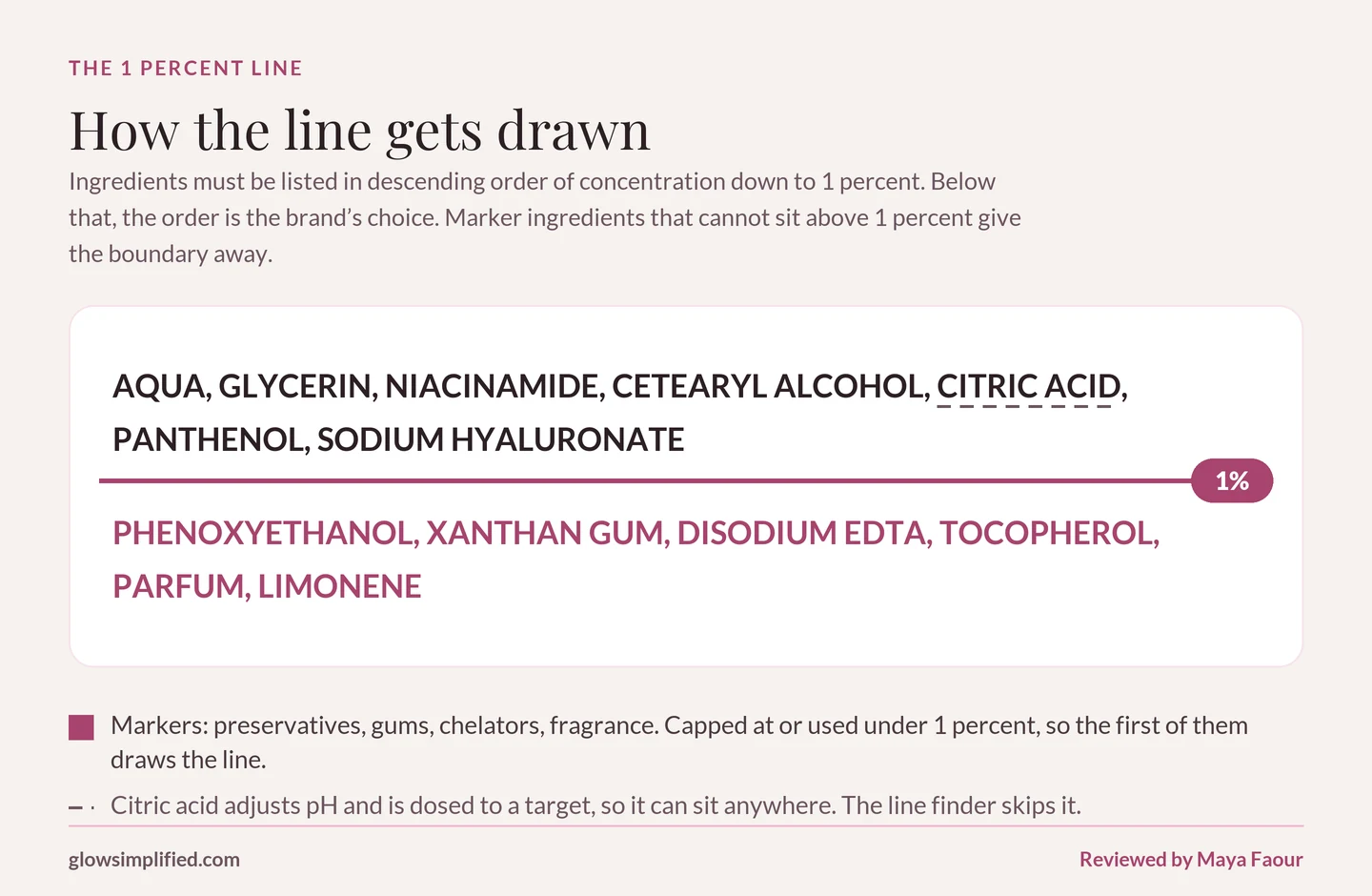
Two guards keep it honest. pH adjusters such as citric acid are dosed to a target and can appear anywhere, so they are never treated as markers. And when no marker is present, the tool refuses to draw a line rather than guess at one.
What this ingredient checker looks at
It is one checker over the same knowledge base that runs the rest of this site, so a cosmetics label, a skin care label or a single ingredient name all get the same reading:
- A verdict for every ingredient we have written up, with the strength of the evidence behind it stated, never implied.
- Conflicts inside the formula: pairings with a known interaction, each linking to its full answer.
- A pregnancy view and a fungal-acne view, both read straight from the knowledge base with their limits stated.
- The 1 percent line, so you can see where the label stops carrying information.
Questions people ask
Is this skincare ingredient checker free?
Yes. No sign-up, no email, and nothing you paste leaves your browser. The paid option on this site is different work: a formulator’s reading of one specific product, concentrations and context included.
Can I just copy and paste the ingredient list?
Yes, that is the whole tool. Paste the list exactly as printed, commas, slashes and all, and it reads the INCI names against our database.
Is there an app?
It is a web tool that works the same on your phone, so there is nothing to install. Save it to your home screen if you want it one tap away.
Does it check for fungal acne?
There is a fungal-acne view, and it tells you exactly how many of our entries carry that flag, so an empty result reads as "not flagged by us", never as "safe for malassezia".
Why is there no product score?
Because a label alone cannot support one. A score needs concentrations and formulation context that no ingredient list reveals, so we grade the evidence behind each ingredient instead and leave the product unscored.