
Skincare basics
Your barrier is probably not missing a cream
It is usually being stressed by something you already own. Here are the signs, the8 ingredients our data flags as all cost and no benefit, and the14 that genuinely rebuild it.
The skin barrier is the outer layer holding water in and irritants out, about10 to 20 micrometres of flat dead cells packed in lipid. When it is overstressed it feels tight, looks dull, and stings at products that used to be fine. The fix is almost never a new cream. It is removing whatever is stressing it, then giving it the three cheap things it rebuilds itself with.
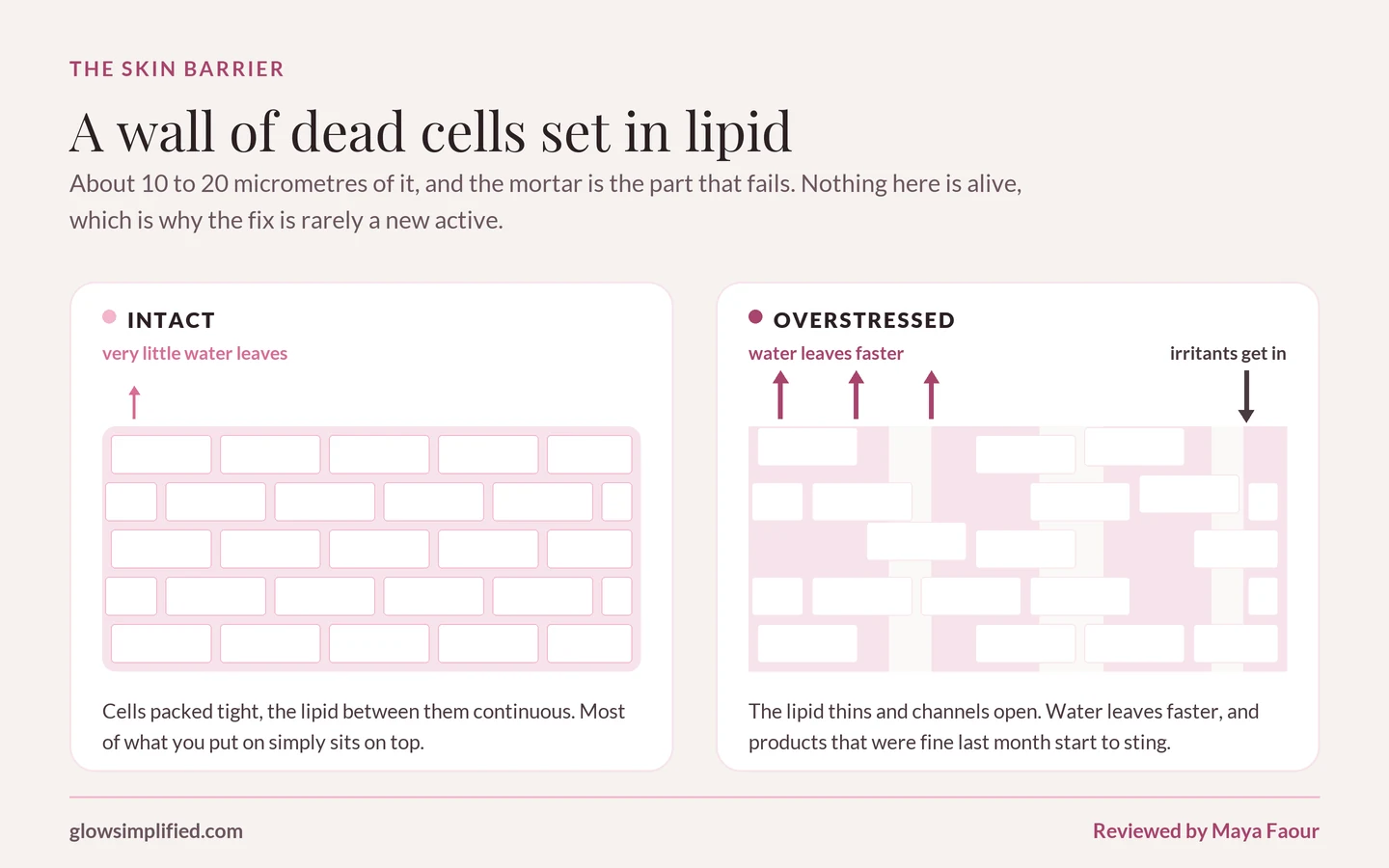
How to tell if your skin barrier is damaged
Clinicians tend to say overstressed rather than damaged, and they describe a spectrum rather than a switch: it starts before anything is visible, moves through visibly dry skin, and at the far end becomes an eczema flare that needs treating. Most people reading this are somewhere in the early part of that line.
- It feels tightEspecially in the few minutes after washing, before anything goes back on.
- It looks dull, rough or flakyDead cells stop shedding evenly and start piling up on the surface.
- Things that used to be fine now stingThe same serum, the same cream, suddenly noticeable. This one is the most telling.
- It itchesNot always visibly, and often worse in cold or dry air.
- Redness hangs aroundLonger than it used to after cleansing, sun, or anything active.
None of this is a diagnosis. If skin is broken, weeping, spreading, or simply not getting better, that is worth a real appointment.
What damages the skin barrier
The usual answer is a list of habits: washing too often, water too hot, air too cold and dry, too many actives at once. All true. But the part nobody selling a barrier cream puts in writing is which ingredients, so here is ours.
These are the 8 our knowledge base rates high for irritation and scores at nothing for barrier support. That combination is the point: plenty of useful ingredients irritate a little and give something back. These give nothing back.
| Ingredient | What it is | Barrier score |
|---|---|---|
| Tazarotene* | drug active | -2 |
| Tretinoin* | drug active | -2 |
| Retinol* | active | -1 |
| Denatured Alcohol | solvent | 0 |
| Fragrance | fragrance | 0 |
| Glycolic acid | exfoliant | 0 |
| Methylisothiazolinone | preservative | 0 |
| Sodium Lauryl Sulfate | surfactant | 0 |
* Retinoids are on this list because they genuinely stress the barrier, and that is not the same as a reason to stop. With a retinoid the irritation usually peaks in the first week or two and then settles as the skin adjusts. If you were prescribed one, changing how you use it is a conversation with whoever prescribed it, not something to decide from a table on a website.
The cleanser matters more than the cream
Sodium lauryl sulfate is first on that list for a reason. Harsh surfactants do structural damage: they denature and swell the proteins in the outer layer and disrupt its lipids, which is a different thing from simply drying skin out. It also keeps doing it when it turns up inside a moisturiser, which happens more than you would like.
There is a quieter mechanism behind "soap is drying" too. Raising the skin's pH adversely affects several barrier functions at once, and traditional soap raises it a lot. If you change one product this week, change the one you rinse off.
Check your own shelf
The honest version of a barrier diagnosis is not a symptom quiz, it is a look at what you are already using. This checks your shelf against the table above. It runs in your browser and nothing is sent anywhere.
Nothing on your shelf yet. Add a few ingredients and come back, or open the shelf in the corner of the screen.
What actually repairs a skin barrier
Three jobs, and between them they cover almost everything that works. Anocclusive slows water escaping while the skin rebuilds. Lipids, meaning ceramides, cholesterol and fatty acids, refill the mortar between the cells; they work best in roughly a 3:1:1 ratio, which is why a formula built around them beats any one of them alone. Humectants hold water in the outer layer so the cells sitting in it can function.
Here is everything our knowledge base scores 8 or higher for barrier support. We did not choose this list, the data did, and that is why it looks nothing like a brand's.
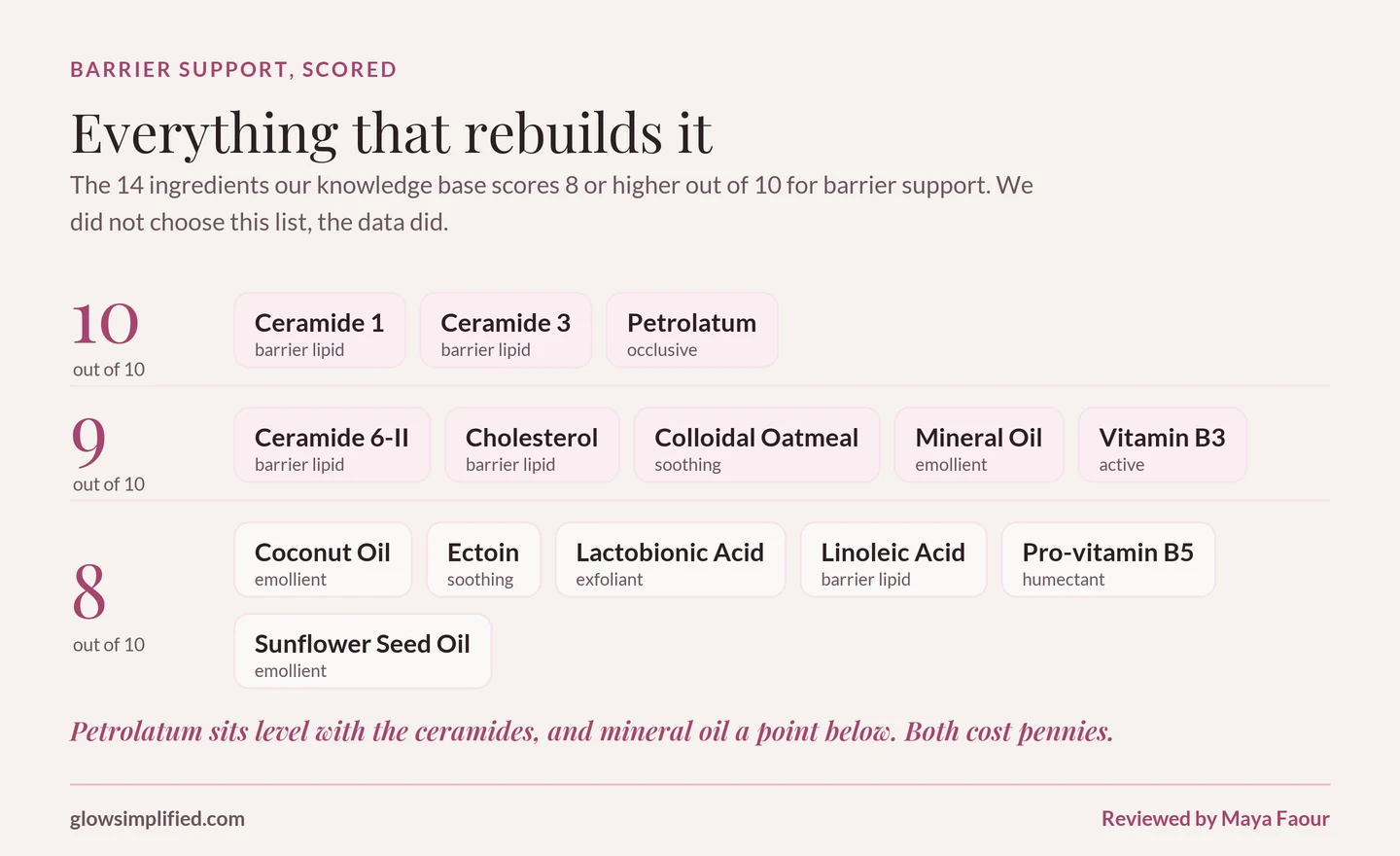
| Ingredient | What it is | Barrier score |
|---|---|---|
| Ceramide 1 | barrier lipid | 10 |
| Ceramide 3 | barrier lipid | 10 |
| Petrolatum | occlusive | 10 |
| Ceramide 6-II | barrier lipid | 9 |
| Cholesterol | barrier lipid | 9 |
| Colloidal Oatmeal | soothing | 9 |
| Mineral Oil | emollient | 9 |
| Vitamin B3 | active | 9 |
| Coconut Oil | emollient | 8 |
| Ectoin | soothing | 8 |
| Lactobionic Acid | exfoliant | 8 |
| Linoleic Acid | barrier lipid | 8 |
| Pro-vitamin B5 | humectant | 8 |
| Sunflower Seed Oil | emollient | 8 |
The cheapest things on that list work the best
Petrolatum scores 10 out of 10, level with the ceramides and above almost everything sold at twenty times the price. Mineral oil scores 9. Both have spent a decade being talked about as though they were harmful, and neither is; they are simply unglamorous, and nothing with a margin gets built on them.
One honest caveat on the oils, because the list is not a licence to slather anything. Sunflower seed oil supports the barrier; olive oil, with its very different fatty acid balance, has been shown to disrupt the outer layer's lipid structure. And coconut oil scores well here while also rating 4 out of 5 for pore-clogging, so it is a good body moisturiser and a questionable face one. Same list, different faces.
How long does it take?
The repair response starts within hours. How long it takes to look and feel better depends on what caused it and how long it went on, and anyone giving you a fixed number is guessing.
Every other page on this subject gives you a number, usually two to four weeks. We looked for the source of that number and could not find one. What is documented is that the skin starts repairing within hours of water loss rising, which is the response beginning rather than the recovery finishing. So we will not invent the rest.
Questions people actually ask
What are the signs of a damaged skin barrier?
Tightness after washing, a dull or flaky look, stinging from products that used to be fine, itching, and redness that lingers. The stinging is the most telling one: when a familiar product starts to sting, something has changed about the skin rather than the product. Dermatologists call the visible end of this xerosis, and describe it as skin that is dull, rough, scaly, flaky and tight.
How long does it take to repair a skin barrier?
The repair response starts within hours. How long it takes to look and feel better depends on what caused it and how long it went on, and anyone giving you a fixed number is guessing.
What damages the skin barrier?
Washing too often or with something too harsh, hot water, cold and dry air, and leave-on products that irritate. Our own data flags 8 ingredients as high-irritation with no barrier benefit at all, led by the cleanser surfactant sodium lauryl sulfate. Anything that raises the skin's pH works against the barrier too, which is the mechanism behind "soap is drying".
Do I need a barrier repair cream?
Usually not a special one. What repairs a barrier is well understood and mostly cheap: an occlusive to slow water loss, lipids like ceramides and cholesterol to refill the gaps, and humectants to hold water in the outer layer. The highest barrier-support scores in our knowledge base go to ceramides and petrolatum, and petrolatum costs almost nothing.
Should I stop using retinol if my barrier is damaged?
Retinoids are on this list because they genuinely stress the barrier, and that is not the same as a reason to stop. With a retinoid the irritation usually peaks in the first week or two and then settles as the skin adjusts. If you were prescribed one, changing how you use it is a conversation with whoever prescribed it, not something to decide from a table on a website.
Is a damaged skin barrier the same as dry skin?
Not quite, though they overlap. Dry skin is one of the visible signs. Clinicians describe a spectrum that starts before anything shows, moves through visibly dry skin, and can end in an eczema flare that needs treating. Where you are on that line matters more than the label.
Sources
- Del Rosso & Kircik 2025, Skin 101: fundamentals of skin barrier physiology
- The role of moisturizers in addressing various kinds of dermatitis
- Skin cleansing without or with compromise: soaps and syndets
- Management of atopic dermatitis: the role of emollient therapy
- Torres et al. 2023, how to promote skin repair
- Why topical retinoids are mainstay of therapy for acne
- Brito et al. 2024, skin structure in topical and transdermal delivery
Reviewed July 2026. Ingredient knowledge base last reviewed July 2026. Not medical advice, and we do not sell a barrier cream.