How skincare works
What does SPF mean? A burn-time ratio, measured at a dose almost nobody applies
The number says how many times more sun it took to redden protected skin than bare skin, in a lab, under a fixed layer of product. Both halves of that sentence matter: the ratio is real, and so is the fixed layer, which is about twice what a typical application actually delivers.
The short answer
The number is honest about what it measured. It just measured a layer you are probably not wearing.
- What does the SPF number actually mean?
- SPF is measured on people: how much simulated sun it takes to just redden skin wearing 2 milligrams of product per square centimetre, divided by how much it takes to redden the same skin bare. An SPF 30 means thirty times the reddening dose, at that tested layer.
- What does SPF 50 mean compared with SPF 30?
- At the tested dose, SPF 30 lets through 1 in 30 units of burning UV, about 3.3 percent, and SPF 50 lets through 1 in 50, about 2 percent. Blocked, that reads 96.7 against 98 percent. The whole comparison has its own page.
- Is it a timer for how long I can stay out?
- No. It is a dose ratio, not a clock: sun intensity moves through the day, and the layer thins as you sweat and touch your face. The standard advice is to reapply on a schedule rather than to multiply minutes.
- Does it cover UVA too?
- Not by itself. SPF is a sunburn measure, and sunburn is mostly UVB. UVA protection is tested and labelled separately.
What SPF means on sunscreen, in one sentence
SPF is measured on people: how much simulated sun it takes to just redden skin wearing 2 milligrams of product per square centimetre, divided by how much it takes to redden the same skin bare. Divide the two doses and you have the SPF. That is all the letters mean on a sunscreen label: sun protection factor, a measured ratio. Nothing in the method involves hours, weather, or your bathroom shelf: it is people, lamps, and a precisely weighed layer of product.
That layer is the part everyone skips. The standard fixes it at 2 milligrams per square centimetre of skin, and every SPF on every bottle, whatever the brand, was earned at exactly that thickness.
Every SPF sits on one curve
Because an SPF lets through 1/SPF of the burning UV, the percentage blocked is 1 − 1/SPF. That single line of arithmetic is the whole story of the numbers war on the shelf, and it flattens fast:
Mostly a UVB number
Because SPF is a sunburn measure and sunburn is driven mostly by UVB, the SPF number says little about UVA on its own. UVA protection is tested separately, and those tests are less standardised.
UVA is less energetic than UVB but more abundant, and it penetrates deeper into the skin, reaching as far as the dermis, where it plays a major role in the deterioration that shows as photoaging.
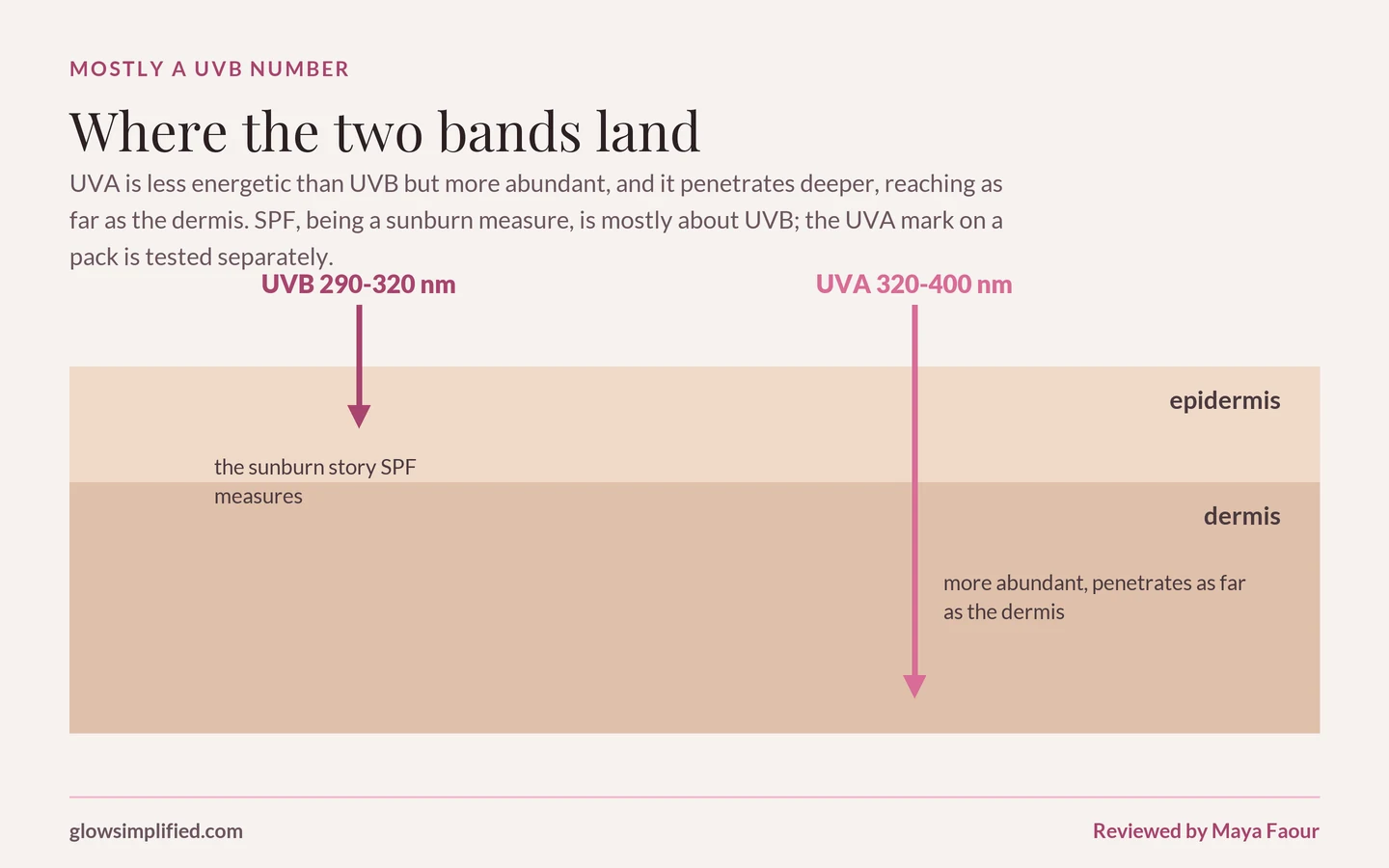
So a high SPF with weak UVA coverage is a product protecting you from the burn you would notice while doing less about the ageing dose you would not. Look for a separate UVA mark on the pack; the SPF number alone does not carry that information.
Measured at a dose almost nobody applies
The tested layer is 2 mg/cm². Measured on real faces, an unguided application delivers about 1.04 mg/cm², which is 52 percent of it. Our sunscreen calculator turns that gap into grams and teaspoons for your own face.
One in vivo study measured what happens to SPF when less is applied and found exponential growth: at half the tested amount the effective SPF fell towards its square root, and at a quarter towards its fourth root.
Those two figures are the study's exponential relation applied to a shelf number, not a measurement of any SPF 50 product; the study used one SPF 4 sunscreen on twenty people. The direction is the point: the amount you apply moves your protection more than the number you buy, which is why reapply at least every two hours, and after swimming, towelling or heavy sweating.
By that study's arithmetic, this behaves like SPF 7.1.
An illustration of one in vivo study, not a measurement of your product.
A ranking, not a guarantee
The same sunscreen measures a higher SPF on people who burn more easily, and lab SPFs differ from sunlight SPFs. The authors conclude SPF should rank sunscreens, not promise an absolute level of protection.
That is how we treat it too: a higher SPF ranks above a lower one, worn the same way. What no number on a bottle can promise is the protection on your particular face on a particular afternoon. For the record, SPF 30 blocks approximately 97% of UVB rays. Above that, the difference is marginal; SPF 50 blocks about 98%.
Sources
Every claim above that is not arithmetic carries a source, resolved through PubMed on 3 September 2026 before it was written down. Where an abstract stopped short of the claim, so did we.
- SPF is measured on people: how much simulated sun it takes to just redden skin wearing 2 milligrams of product per square centimetre, divided by how much it takes to redden the same skin bare.ISO 24444:2019, the in vivo SPF method (already the anchor of our sunscreen calculator), and Bens G. Sunscreens. Adv Exp Med Biol 2014;810:429-63. PMID 25207381: "Protection from UVB is quantified as a minimal erythema dose-based sun protection factor."
- Because SPF is a sunburn measure and sunburn is driven mostly by UVB, the SPF number says little about UVA on its own. UVA protection is tested separately, and those tests are less standardised.Bens G. Sunscreens. Adv Exp Med Biol 2014;810:429-63. PMID 25207381. UVA testing named as less standardised, with persistent pigment darkening and critical wavelength as the current methods.
- UVA is less energetic than UVB but more abundant, and it penetrates deeper into the skin, reaching as far as the dermis, where it plays a major role in the deterioration that shows as photoaging.Battie C, Verschoore M. Cutaneous solar ultraviolet exposure and clinical aspects of photodamage. Indian J Dermatol Venereol Leprol 2012;78 Suppl 1:S9-14. PMID 22710112. An industry-affiliated review (both authors L’Oréal Research); the abstract states UVA "is more abundant and penetrates deeper into the skin, reaching as far as the dermis", with UVB at 290-320 nm and UVA at 320-400 nm.
- One in vivo study measured what happens to SPF when less is applied and found exponential growth: at half the tested amount the effective SPF fell towards its square root, and at a quarter towards its fourth root.Faurschou A, Wulf HC. The relation between sun protection factor and amount of sunscreen applied in vivo. Br J Dermatol 2007;156(4):716-9. PMID 17493070. 20 volunteers, one SPF 4 product at 0.5, 1, 2 and 4 mg/cm2; exponential fit r2 = 0.903.
- The same sunscreen measures a higher SPF on people who burn more easily, and lab SPFs differ from sunlight SPFs. The authors conclude SPF should rank sunscreens, not promise an absolute level of protection.Damian DL, Halliday GM, Barnetson RS. Sun protection factor measurement of sunscreens is dependent on minimal erythema dose. Br J Dermatol 1999;141(3):502-7. PMID 10583055.
The tested and typical doses, the reapplication guidance and the 97/98 percent figures are the sunscreen calculator's own sourced constants, printed with their sources on that page.
Corrections and updates
Nothing has been corrected on this page since it was published. If that changes, the change will be listed here with its date rather than quietly edited in.
Last re-read against its sources on . If you find an error, tell us and we will fix it and say so.
Get the next one
We read the primary papers, write to the researchers, and print what they say. If that is useful, the free plain-words routine guide comes with it. No spam, and nothing sold here.