Ingredient glossary
Acetylated Hyaluronic Acid
On your shelf ✓What Acetylated Hyaluronic Acid does for your skin, who it suits, and what to watch for.
INCI: Sodium Acetylated Hyaluronate · Also: Super Hyaluronic Acid
In short: Acetylated Hyaluronic Acid delivers hydration and film forming, suits most skin types, and the evidence behind it is emerging.
- What it does
- Hydration, film forming
- Best for
- Most skin types
- Evidence
- Emerging
- How long
- Straight away
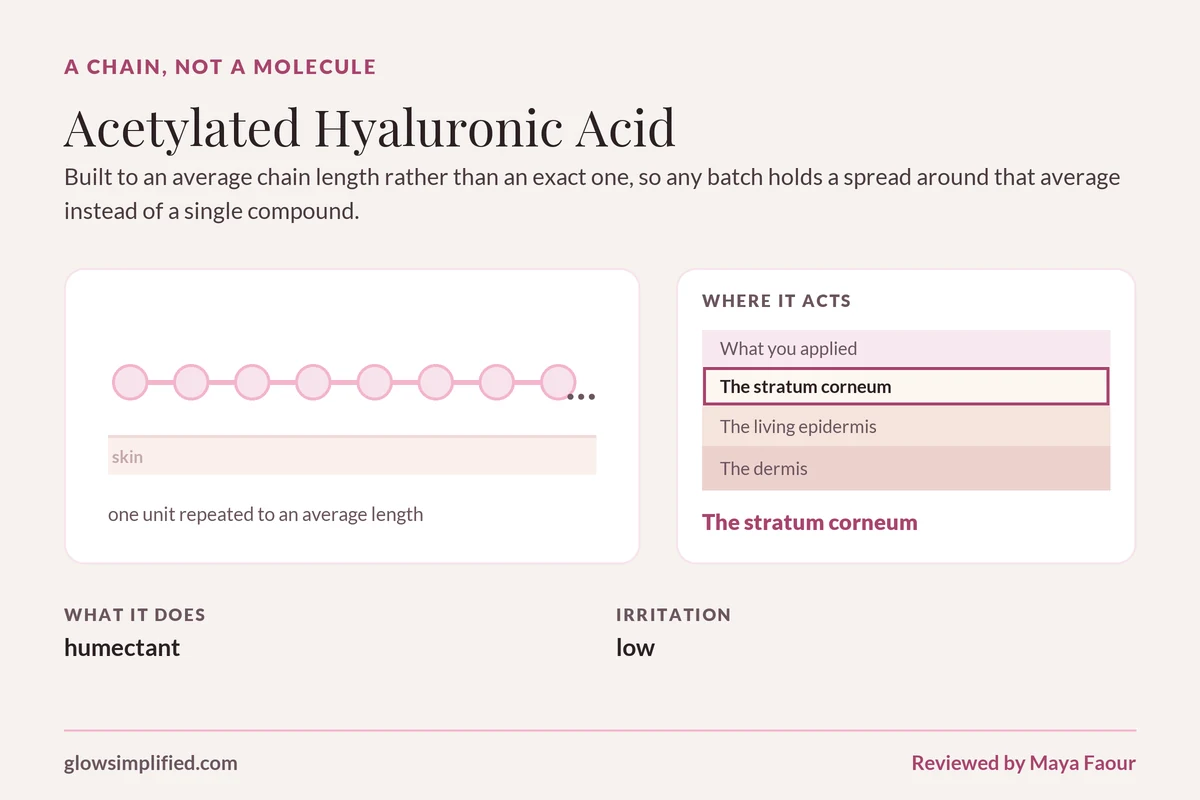
What it actually is
The Glow take
Nice to have, and nothing to overthink.
Acetylated Hyaluronic Acid plays a quiet supporting role, rounding out a formula rather than being the reason you buy it.
— Maya
What it does
- hydration
- film forming
emerging evidenceOne supplier linked clinical study found roughly 4 to 11 percent reduction in wrinkle measures after 28 days of a 0.1 percent cream, with ex vivo work suggesting the acetyl groups slow enzyme breakdown. The claimed hydration advantage over ordinary sodium hyaluronate at matched dose has never been shown in a published head to head trial, so we score it as hyaluronic acid with an unproven bonus.
Who it's for, and who should skip it
Tends to suit
- dry
- normal
- sensitive
Approach with care
- rare allergy
- Clogs poresLow
- Irritation riskLow
How it fits each skin type
- DrySuits
- CombinationSuits
- OilySuits
- SensitiveSuits
Take extra care if any of these apply to you: rare allergy.
Where it fits in your routine
This one works on contact — there is nothing to wait for.
What that covers, and what it does not
Measured on: visible surface smoothing and wrinkle filling from the applied film — crow's-feet wrinkle count and nasolabial wrinkle area, imaged 6 hours after a single application against a placebo-treated half-face.
This ingredient does have vehicle-controlled human data, and not one study but three, run by the supplier and published together, all double-blind, placebo-controlled and half-face. Twenty-one women aged 42-70 applied 0.2% and were read once at 6 hours: 6% fewer total crow's-feet wrinkles than the placebo side, and a shrinking coarse nasogenian area where the placebo side grew (p<0.05 for both). Twenty women applied 0.1% twice daily and were read at day 28: 9% fewer nasogenian wrinkles, 12% smaller total wrinkle area and 13% fewer medium lines than placebo. Thirty women applied 0.1% twice daily and were read at day 56: 9% less surface roughness than placebo. The bucket sits at the 6-hour read because that is the earliest point at which the ingredient separated from its placebo and it is a film effect a user can see the same day; the 28-day and 56-day arms each have a single endpoint read, so neither of them dates an onset either. What to hold against all of it: every effect size is single-digit percent, the 6-hour arm ran at double the concentration of the multi-week arms, all authors are employed by the ingredient's supplier, and nobody independent has repeated any of it. The hydration axis the base scores highest still has no published time course, and the claim that it out-hydrates ordinary sodium hyaluronate at matched dose remains unshown in any head-to-head; the ex vivo work on acetyl groups resisting hyaluronidase is mechanism, not a timeline.
Meunier M, Scandolera A, Chapuis E, Lapierre L, Sandré J, Brunner G, Lovchik M, Reynaud R. 'The anti-wrinkles properties of sodium acetylated hyaluronate.' J Cosmet Dermatol. 2022;21(7):2749-2762. PMID:34708918 (DOI:10.1111/jocd.14539) — three double-blind placebo-controlled half-face studies (6 h at 0.2%, n=21; day 28 at 0.1%, n=20; day 56 at 0.1%, n=30). All authors affiliated with Givaudan Active Beauty, the ingredient's supplier; no independent replication located.
Plays well with
Acetylated Hyaluronic Acid, answered
Is Acetylated Hyaluronic Acid safe during pregnancy?
Yes. Acetylated Hyaluronic Acid is considered safe to use during pregnancy and breastfeeding. As with anything, if you are unsure it is worth a quick word with your doctor or midwife.
Who should avoid Acetylated Hyaluronic Acid?
Approach Acetylated Hyaluronic Acid with care if any of these apply to you: rare allergy.
What concentration of Acetylated Hyaluronic Acid actually works?
Its concentration is rarely printed on the label, so use the ingredient list as your clue: near the top third it is likely doing real work, near the bottom it is more of a sprinkle.
Compare Acetylated Hyaluronic Acid with
- Hyaluronic acid
- Pro-vitamin B5
- Sodium PCA
- Aloe
- Butylene Glycol
- Propanediol
- Betaine
- Trehalose
- Xylitol
- Hydroxyethyl Urea
- Glycereth-26
- Polyglutamic Acid
- Tremella Fuciformis Extract
- Beta-Glucan
- Hydrolyzed Collagen
- Honey
- Pentylene Glycol
- Crosslinked sodium HA
- Propylene Glycol
- Hydrolyzed hyaluronic acid
- Fructooligosaccharides
- Hexylene Glycol
Can you mix Acetylated Hyaluronic Acid with
This, for every label you own
One ingredient is easy. A full label is where it gets confusing. The Ingredient Decoder reads any product and tells you the honest truth, ingredient by ingredient.
Sources & how we reviewed this
- DOI 10.1111/jocd.14539abstract only, the full text is paywalled
- DOI 10.1248/cpb.c23-00094summary page only, the document itself was not read