Ingredient glossary
Beta-Glucan
On your shelf ✓What Beta-Glucan does for your skin, who it suits, and what to watch for.
INCI: Beta-Glucan · Also: Oat Beta-Glucan, Pleuran
In short: Beta-Glucan delivers hydration and barrier support, suits dry and sensitive skin best, and the evidence behind it is moderate.
- What it does
- Hydration, barrier support
- Best for
- Dry, Sensitive skin
- Evidence
- Moderate
- How long
- Never measured
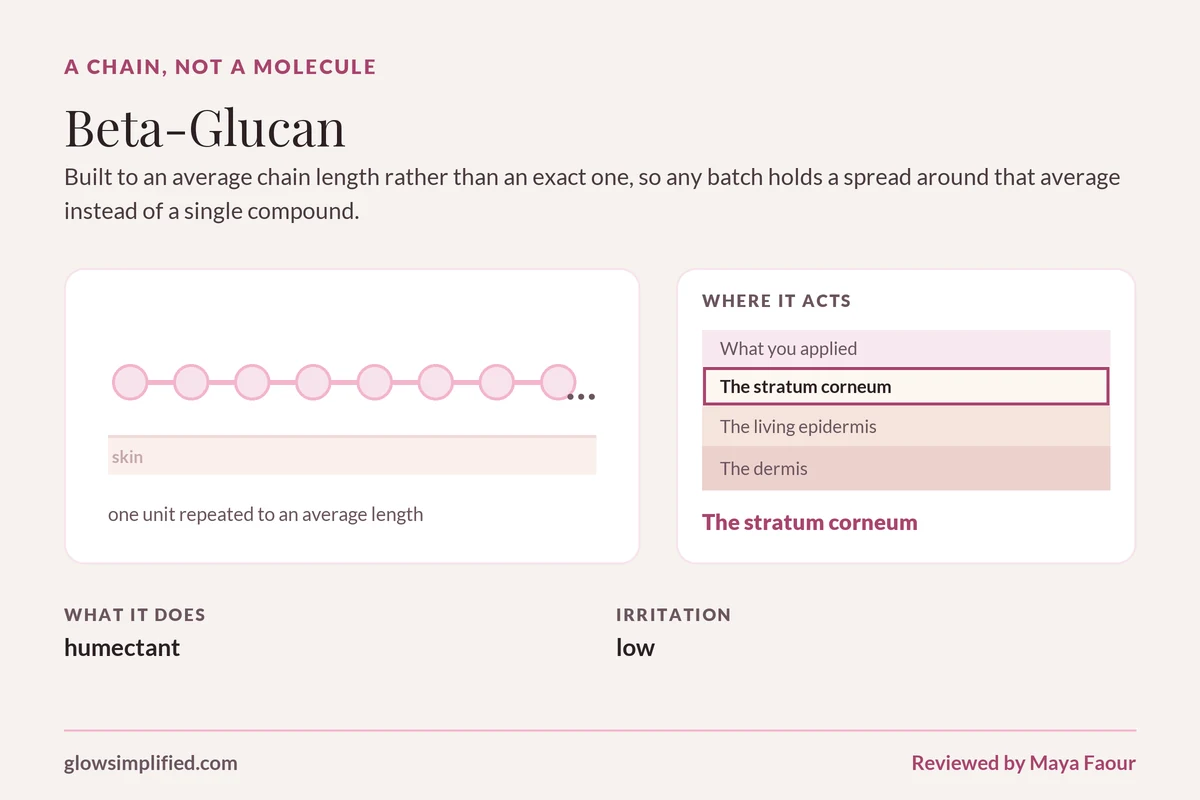
What it actually is
The Glow take
Genuinely worth a spot in your routine.
When your goal is deep, lasting hydration, Beta-Glucan pulls genuine weight, with a solid amount of evidence behind it. It tends to suit dry skin best.
— Maya
What it does
- hydration
- barrier support
- soothing
- anti aging
moderate evidenceClinical and mechanistic studies show topical beta glucan improves atopic dermatitis scores enhances barrier markers and reduces wrinkle depth at around zero point five percent with good tolerability.
On a label: usually effective at 0.2-1%.
Who it's for, and who should skip it
Tends to suit
- dry
- dehydrated
- sensitive
- very sensitive
- compromised barrier
- photoaged
- atopic
Approach with care
No specific group flagged to avoid it.
- Clogs poresLow
- Irritation riskLow
- Allergen originComes from oats
How it fits each skin type
- DrySuits
- CombinationNeutral
- OilyNeutral
- SensitiveSuits
Often chosen for compromised barrier, photoaged, atopic.
Where it fits in your routine
Nobody has published how long this takes to work.
What is known, and what is missing
Measured on: barrier recovery, soothing of inflamed skin and wrinkle depth - the barrier_support 7 and anti_aging 6 jobs this row is scored and sold for.
There is a genuine on-contact effect and it is the smaller half of this ingredient: a soluble high-molecular-weight glucan is a water-binding polymer, so a corneometer reading rises as soon as the film is on the skin, and it goes with the next cleanse. That film is not barrier recovery, not calming and not wrinkle depth, which are what this row scores 7 and 6 and what its own summary promises. None of those has been dated. The 8-week wrinkle-height and roughness result in 27 subjects is a supplier-authored conference abstract, not a full trial with a reported visit schedule; the atopic-dermatitis evidence tests beta-glucan-containing emollients against other emollients, so the polysaccharide's own contribution and its onset are both unattributable. Penetration of yeast-derived glucan into the epidermis has been shown in laboratory work, which is a mechanism, not a timeline. Missing specifically: any vehicle-controlled study of beta-glucan alone at 0.2-1% reporting the first visit at which a barrier, soothing or wrinkle endpoint moved. Two further controlled studies exist and still do not date the endpoints this row is scored for: the 2008 placebo controlled trials used a chitin glucan copolymer rather than beta glucan itself and the 2021 split face post laser study tested finished multi ingredient regimens so neither isolates beta glucan or reports when its own effect first appears.
No vehicle-controlled single-ingredient time course located. The 8-week wrinkle claim traces to a conference abstract in Int J Cosmet Sci 2005 (Pillai, Redmond and Roding), described rather than treated as a dateable trial; the atopic-dermatitis literature covers finished beta-glucan emollients. No PMID asserted.
Plays well with
- panthenol
- ceramides
- humectants
Beta-Glucan, answered
Is Beta-Glucan safe during pregnancy?
Yes. Beta-Glucan is considered safe to use during pregnancy and breastfeeding. As with anything, if you are unsure it is worth a quick word with your doctor or midwife.
Who should avoid Beta-Glucan?
No specific group is flagged to avoid Beta-Glucan. It is well tolerated by most skin. Still, introduce anything new one product at a time.
What concentration of Beta-Glucan actually works?
Beta-Glucan tends to do its job in the 0.2 to 1% range. Much lower and it is likely underdosed.
Compare Beta-Glucan with
- Hyaluronic acid
- Pro-vitamin B5
- Sodium PCA
- Aloe
- Butylene Glycol
- Propanediol
- Betaine
- Trehalose
- Xylitol
- Hydroxyethyl Urea
- Glycereth-26
- Polyglutamic Acid
- Tremella Fuciformis Extract
- Hydrolyzed Collagen
- Honey
- Pentylene Glycol
- Crosslinked sodium HA
- Propylene Glycol
- Hydrolyzed hyaluronic acid
- Acetylated Hyaluronic Acid
- Fructooligosaccharides
- Hexylene Glycol
This, for every label you own
One ingredient is easy. A full label is where it gets confusing. The Ingredient Decoder reads any product and tells you the honest truth, ingredient by ingredient.
Sources & how we reviewed this
- PMID 19099547abstract only, the full text is paywalled
- DOI 10.1111/jocd.13798abstract only, the full text is paywalled