
Ingredient pairing
Can you mix Papain and Sponge spicules?
Same answer whichever way you searched it: Sponge spicules and Papain.
Use with careUse these with care.
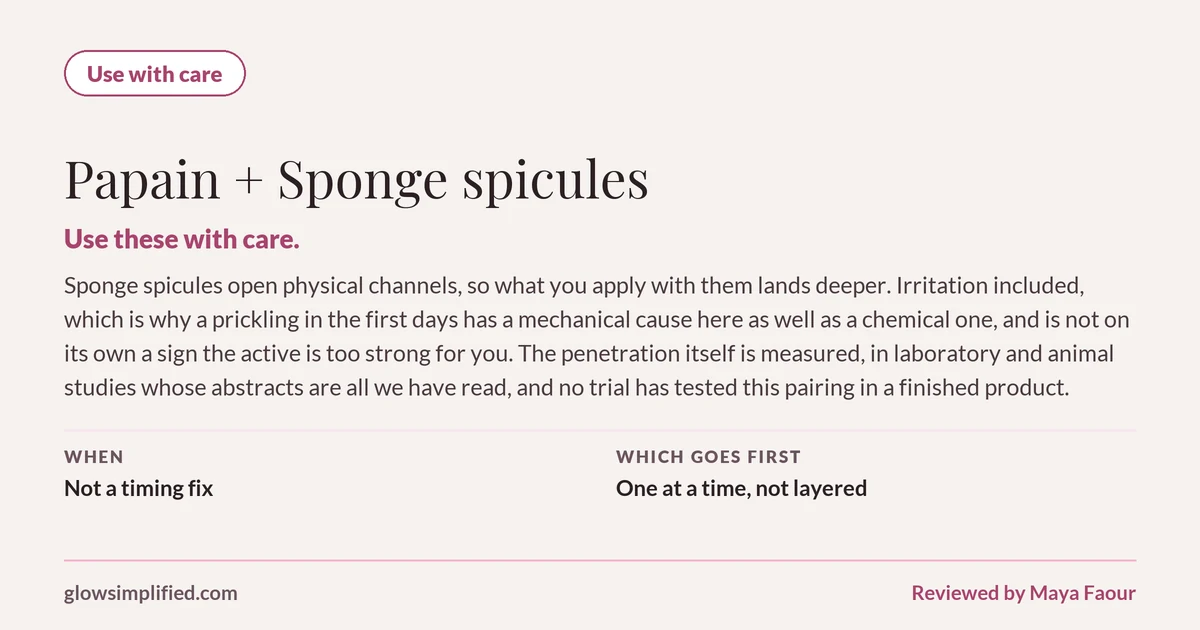
Sponge spicules open physical channels, so what you apply with them lands deeper. Irritation included, which is why a prickling in the first days has a mechanical cause here as well as a chemical one, and is not on its own a sign the active is too strong for you. The penetration itself is measured, in laboratory and animal studies whose abstracts are all we have read, and no trial has tested this pairing in a finished product.
Do this: Introduce them one at a time, and hold off on other strong actives for the first few weeks, so if your skin does react you know which one to look at.
Routine: Not a morning-or-night problem: start one, let your skin settle, then add the other.
Skip if: very sensitive, rosacea, compromised barrier, papaya allergy
Ask your doctor in pregnancySkip if: very sensitive, compromised barrier, rosacea, eczema
Which one goes first?
One at a time, not layered
With Sponge spicules in the routine, whatever follows lands deeper. So the useful question is not whether Papain goes on first. It is how long you wait before adding it at all.
How to introduce Papain and Sponge spicules
- Patch test each one first: a coin-sized amount on your inner forearm for two or three days, watching for redness or stinging.
- Do not start both in the same week: settle into one of them on its own, then add the other only once your skin is comfortable.
- Start the spicules at once or twice a week and increase gradually, giving your skin time to settle between steps.
- If skin turns tight, flaky, red or starts to sting, drop back a step and let your barrier recover for a few days before pushing on again.
There is room for both here, as long as you build up gently and let your skin set the pace.
For your skin type If your skin is sensitive or reactive, take this pair slowly: Sponge spicules are the higher-irritation ingredient here, and using actives close together magnifies that.
Also worth checking
More pairings with Papain
More pairings with Sponge spicules
Papain and Sponge spicules, answered
Can you mix Papain and Sponge spicules?
Use these with care. Sponge spicules open physical channels, so what you apply with them lands deeper. Irritation included, which is why a prickling in the first days has a mechanical cause here as well as a chemical one, and is not on its own a sign the active is too strong for you. The penetration itself is measured, in laboratory and animal studies whose abstracts are all we have read, and no trial has tested this pairing in a finished product. Introduce them one at a time, and hold off on other strong actives for the first few weeks, so if your skin does react you know which one to look at.
Should you use Papain and Sponge spicules in the morning or at night?
Time of day is not what matters here. Start one of them, let your skin settle, and only then add the other.
How should you introduce Papain and Sponge spicules?
Patch test each one first: a coin-sized amount on your inner forearm for two or three days, watching for redness or stinging. Do not start both in the same week: settle into one of them on its own, then add the other only once your skin is comfortable. Start the spicules at once or twice a week and increase gradually, giving your skin time to settle between steps. If skin turns tight, flaky, red or starts to sting, drop back a step and let your barrier recover for a few days before pushing on again. There is room for both here, as long as you build up gently and let your skin set the pace.
What else should you not mix with Papain?
Papain is best kept apart from Retinol, Retinal, Hydroxypinacolone Retinoate, Retinyl Palmitate. Introduce any new active one at a time.
Sources
- Zhang et al., "Enhanced skin delivery of therapeutic peptides using spicule-based topical delivery systems" (Pharmaceutics, 2021), abstract read
- Li et al., "Percutaneous extraction using sponge spicules" (Scientific Reports, 2025), abstract read
Plus how we reach every verdict: how we score →
General guidance, not medical advice. When in doubt, introduce one product at a time, andhere is when to see a dermatologist instead.