Ingredient glossary
Acryloyl Taurate Copolymer
On your shelf ✓What Acryloyl Taurate Copolymer does for your skin, who it suits, and what to watch for.
INCI: Hydroxyethyl Acrylate/Sodium Acryloyldimethyl Taurate Copolymer · Also: Sodium Acrylate/Sodium Acryloyldimethyl Taurate Copolymer, Acryloyldimethyl Taurate Copolymer
In short: Acryloyl Taurate Copolymer delivers viscosity control and texture, plays a broad, supporting role, and the evidence behind it is moderate.
- What it does
- Viscosity control, texture
- Best for
- A broad, supporting role
- Evidence
- Moderate
What it actually is
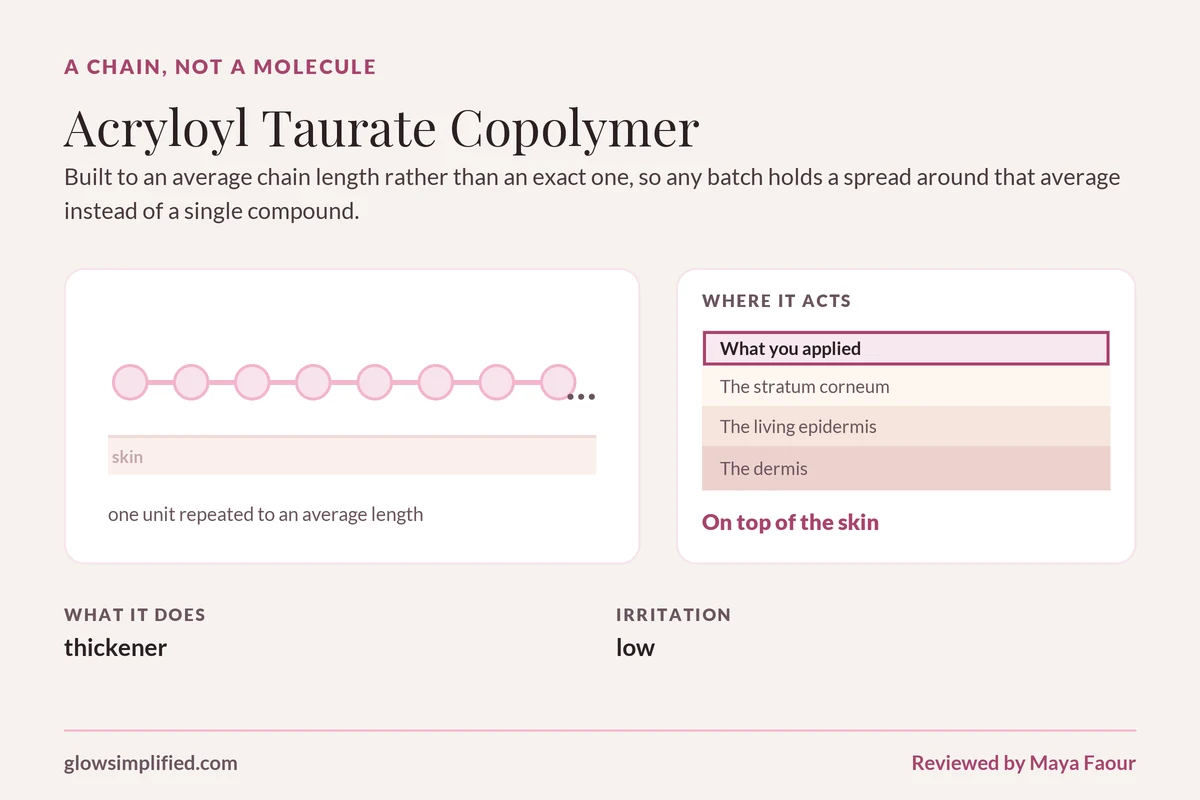
The Glow take
Nice to have, and nothing to overthink.
Acryloyl Taurate Copolymer plays a quiet supporting role, rounding out a formula rather than being the reason you buy it.
— Maya
What it does
- viscosity control
- texture
- emulsification
moderate evidenceNo efficacy trials exist and none are expected, because this is a texture polymer rather than an active. Two regulators have assessed it: Australia's NICNAS cleared it in 2004 as a polymer of low concern, used as a thickener below 3 percent, and the CIR Expert Panel's 2017 review of the acryloyldimethyltaurate family found them safe in the present practices of use, with the US industry survey reporting real-world levels from 0.15 to 4.3 percent. It is itself non-surfactant and acts as an emulsion stabiliser. Non-irritating in a single human irritation assay submitted by the notifier and reported without study details. It works on texture, never on skin.
On a label: usually effective at 0.5-3%.
Who it's for, and who should skip it
Tends to suit
No specific skin type. It is a broadly used ingredient.
Approach with care
No specific group flagged to avoid it.
- Clogs poresLow
- Irritation riskLow
How it fits each skin type
- DryNeutral
- CombinationNeutral
- OilyNeutral
- SensitiveNeutral
Where it fits in your routine
Plays well with
- emulsifiers
- film formers
- humectants
Acryloyl Taurate Copolymer, answered
Is Acryloyl Taurate Copolymer safe during pregnancy?
Yes. Acryloyl Taurate Copolymer is considered safe to use during pregnancy and breastfeeding. As with anything, if you are unsure it is worth a quick word with your doctor or midwife.
Who should avoid Acryloyl Taurate Copolymer?
No specific group is flagged to avoid Acryloyl Taurate Copolymer. It is well tolerated by most skin. Still, introduce anything new one product at a time.
What concentration of Acryloyl Taurate Copolymer actually works?
Acryloyl Taurate Copolymer tends to do its job in the 0.5 to 3% range. Much lower and it is likely underdosed.
This, for every label you own
One ingredient is easy. A full label is where it gets confusing. The Ingredient Decoder reads any product and tells you the honest truth, ingredient by ingredient.