
Ingredient glossary
Carbomer
On your shelf ✓What Carbomer does for your skin, who it suits, and what to watch for.
INCI: Carbomer · Also: Carbomer 940, Carbomer 980
In short: Carbomer delivers viscosity control and texture, plays a broad, supporting role, and the evidence behind it is strong. One thing to know: needs the right pH to work.
- What it does
- Viscosity control, texture
- Best for
- A broad, supporting role
- Watch out
- Needs the right pH to work
- Evidence
- Strong
What it actually is
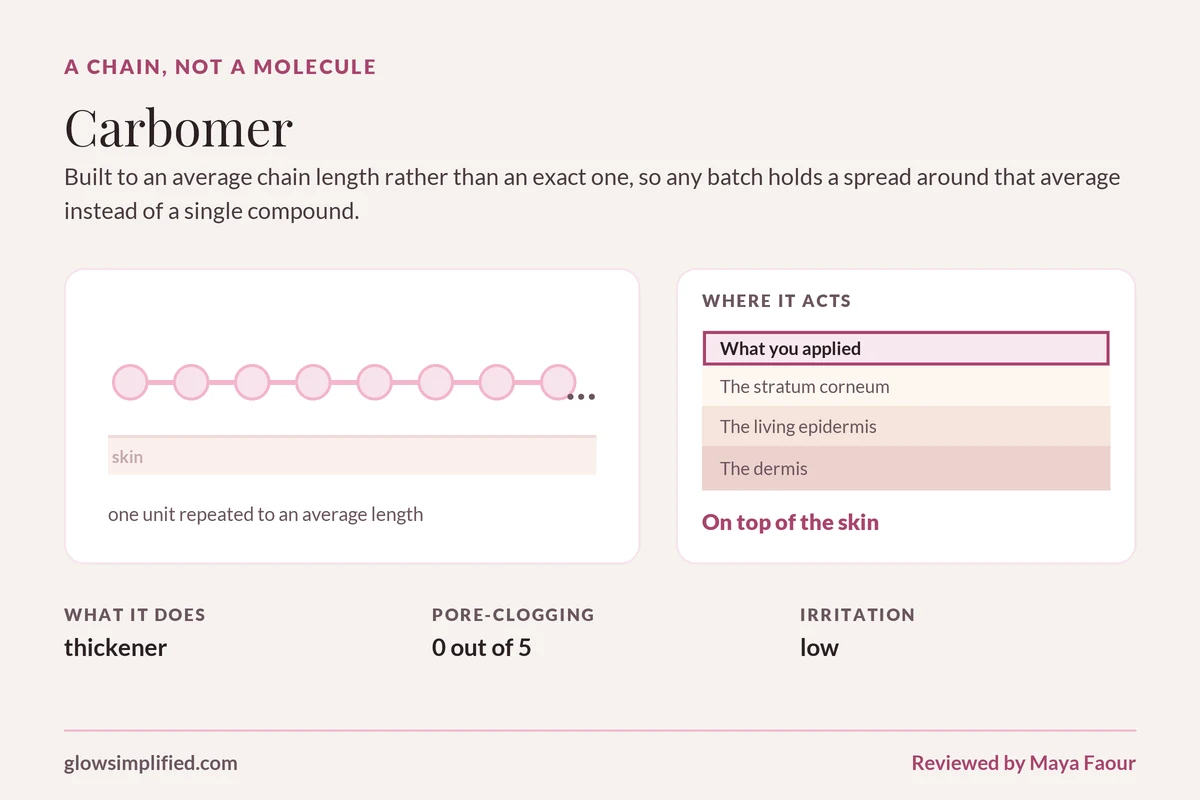
The Glow take
Nice to have, and nothing to overthink.
Carbomer plays a quiet supporting role, rounding out a formula rather than being the reason you buy it.
— Maya
What it does
- viscosity control
- texture
- film forming
strong evidenceCarbomer dispersions stay thin at acidic pH and need neutralizing into the 5 to 7 range to uncoil the polymer, build viscosity and suspend particles, typically at 0.1 to 1 percent. Reports of pilling depend on the whole formula, not the polymer alone.
On a label: usually effective at 0.1-1%.
Who it's for, and who should skip it
Tends to suit
No specific skin type. It is a broadly used ingredient.
Approach with care
No specific group flagged to avoid it.
- Irritation riskLow
- pH-dependentIts effect depends on the product's pH
How it fits each skin type
- DryNeutral
- CombinationNeutral
- OilyNeutral
- SensitiveNeutral
Where it fits in your routine
Plays well with
- film formers
- emulsifiers
- preservatives
Carbomer, answered
Is Carbomer safe during pregnancy?
Yes. Carbomer is considered safe to use during pregnancy and breastfeeding. As with anything, if you are unsure it is worth a quick word with your doctor or midwife.
Who should avoid Carbomer?
No specific group is flagged to avoid Carbomer. It is well tolerated by most skin. Still, introduce anything new one product at a time.
What concentration of Carbomer actually works?
Carbomer tends to do its job in the 0.1 to 1% range. Much lower and it is likely underdosed.
Does it clog pores?
No comedogenicity data published; considered non pore clogging.
- This rating comes from old lab tests on the isolated ingredient, not the finished product.
- The full formula, how much is used, and your own skin all matter more than one number.
- If you are acne-prone it is worth noticing, not a reason to avoid it on sight.
Checking a whole product? Paste its list into the pore-clogging checker →
This, for every label you own
One ingredient is easy. A full label is where it gets confusing. The Ingredient Decoder reads any product and tells you the honest truth, ingredient by ingredient.