Words on the label
Non-comedogenic meaning: what the label actually promises
Non-comedogenic is a claim that a product is unlikely to block pores and cause blackheads or whiteheads. Nobody verifies it. There is no standard test, no legal definition and no authority that signs it off, so the words on the front are the brand’s own opinion of its formula. What does exist is a published 0 to 5 comedogenic scale for individual ingredients, and you can read a label against it yourself.
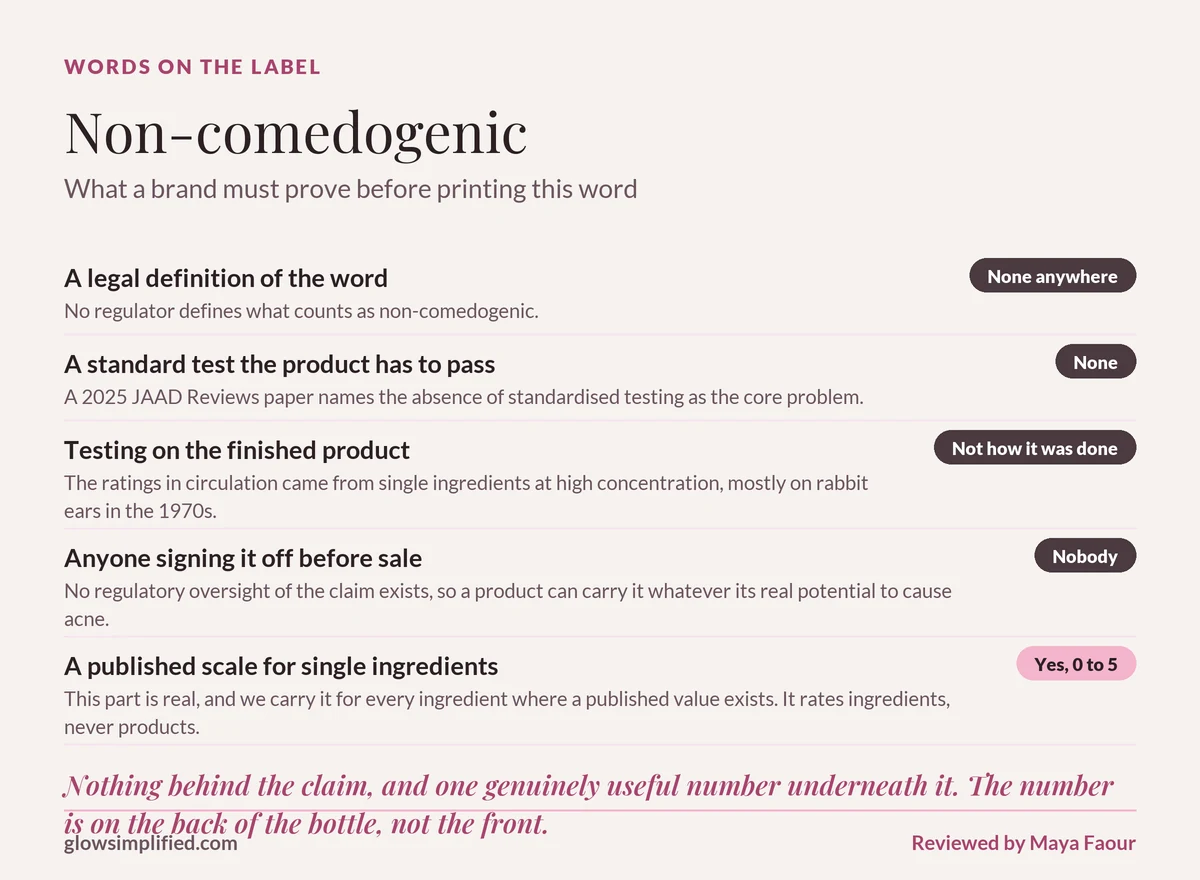
What a brand must prove before printing this word
- A legal definition of the wordNone anywhereNo regulator defines what counts as non-comedogenic.
- A standard test the product has to passNoneA 2025 JAAD Reviews paper names the absence of standardised testing as the core problem.
- Testing on the finished productNot how it was doneThe ratings in circulation came from single ingredients at high concentration, mostly on rabbit ears in the 1970s.
- Anyone signing it off before saleNobodyNo regulatory oversight of the claim exists, so a product can carry it whatever its real potential to cause acne.
- A published scale for single ingredientsYes, 0 to 5This part is real, and we carry it for every ingredient where a published value exists. It rates ingredients, never products.
Nothing behind the claim, and one genuinely useful number underneath it. The number is on the back of the bottle, not the front.
How comedogenic ratings actually work
The numbers everyone quotes come from work done in the 1970s and 1980s. Researchers applied single ingredients, usually at high concentration, to the inside of a rabbit’s ear and scored how badly the follicles blocked up. That produced the 0 to 5 scale still in circulation: 0 for no measurable clogging, 5 for the worst of it.
A 2025 clinical review in JAAD Reviews traces exactly what happened next. The rabbit ear assay set the original ratings, but when the same substances were tested on human skin the results came out inconsistent. The method also tests ingredients on their own rather than as part of a finished product, which is not how anything reaches your face, and people vary enormously in how their own follicles respond.
On top of that, the review notes there is no standardised test and no regulatory oversight of the claim, which lets a company label a product noncomedogenic regardless of its actual potential to cause acne. Its recommendation is the sensible one: judge a product by its ingredient list and your own skin, not by the marketing on the box.
What our data shows
We carry the published rating for every ingredient where one exists, and we show it whether or not it flatters the ingredient. Both ends of the scale are worth seeing together, because the claim on a bottle only ever gestures at one of them.
At the top are the ingredients rating at or near 5 in isolation, which is what the claim is supposed to be protecting you from. Read the note beside each one: a surfactant that rates 5 in a cleanser you rinse off in twenty seconds is a very different proposition from a rich ester sitting on your face all night. At the bottom, rated 0, are ingredients plenty of people avoid on reputation alone. Butters and plant oils are not automatically the problem, and light-feeling esters are not automatically safe.
| Ingredient | Rating | What the number means here |
|---|---|---|
| Sodium Lauryl Sulfate | 5High | Rated at the top in isolation, but it is mainly a rinse-off cleanser, so contact time is short. |
| Isopropyl Myristate | 5High | One of the most pore-clogging emollients in the old lab tests. |
| Myristyl Myristate | 5High | A waxy ester at the top of the published scale. |
| Coconut Oil | 4High | Famously pore-clogging for many faces in leave-on products. |
| Argan Oil | 0Non-comedogenic | Widely rated non-comedogenic. |
| Shea Butter | 0Non-comedogenic | Rich but widely rated non-comedogenic in lab tests. |
| Sunflower Seed Oil | 0Non-comedogenic | High in linoleic acid and generally friendly to acne-prone skin. |
| Hemp Seed Oil | 0Non-comedogenic | Very high in linoleic acid; the bottom of the scale. |
See every rated ingredient, or paste your own list into the pore-clogging checker →
Every name links to its full glossary page. The ratings are the published values, and they describe an isolated ingredient in a lab, not the product in your hand.
What to do instead of trusting the label
Read the list. It takes a minute and it tells you more than the word ever will. Paste a product’s full ingredient list into our pore-clogging checker and it flags every ingredient carrying a published rating, in both directions: the ones worth noticing and the ones with a bad reputation and a low number.
Then do the slow part. Introduce one new product at a time and give it a few weeks, because a breakout that starts the day after you changed three things tells you nothing about which one did it. If you already track what you use, your shelf makes that easier to see.
Questions, answered
Is non-comedogenic regulated?
No. There is no legal definition of the term and no standard test behind it, and no authority approves it before a product goes on sale. A 2025 clinical review in JAAD Reviews describes exactly this gap: without standardised testing or oversight, companies can use the label regardless of a product’s real potential to cause acne.
Does non-comedogenic mean oil-free?
No, and the two get confused constantly. Oil-free is a claim about what is in the bottle. Non-comedogenic is a claim about what the product does to your pores. Plenty of oils rate at the bottom of the comedogenic scale, and plenty of oil-free formulas contain esters and emulsifiers that rate near the top.
Can non-comedogenic products still cause breakouts?
Yes. The claim is unverified to begin with, the ratings behind it come from isolated ingredients rather than finished formulas, and skin varies from person to person. A product can be perfectly reasonable and still break you out. That is information about your skin, not proof the brand lied.
What rating counts as pore-clogging?
On the published 0 to 5 scale, 0 is non-comedogenic, 1 to 2 is low, 3 is moderate and 4 to 5 is high. If your skin congests easily, 3 and above is the range worth noticing in a leave-on product. Treat it as a flag to check, not a reason to reject a whole formula over one line of an ingredient list.
Sources
- Starzyk T, Aust N, Schur N, Miller R. "Comedogenicity in cosmeceuticals: A review of clinical relevance, regulatory gaps, and future directions." JAAD Reviews, 2025 (open access)
- US Food and Drug Administration, Cosmetics Labeling Claims
- Commission Regulation (EU) No 655/2013, common criteria for cosmetic claims
- Glow Simplified, "How we score": our own method and its limits
Cosmetic rules differ by country, and the wording on a label is written for the market it sells in. General guidance, not medical advice. Here is when to see a dermatologist instead.