Words on the label
Hypoallergenic meaning: what the label actually promises
Hypoallergenic means the company believes its product is less likely to cause a reaction. That is the whole of it. There is no legal definition, no standard test a product has to pass, and no list of ingredients it has to leave out, so two bottles carrying the same word can hold very different formulas. It is a marketing claim, not a safety grade.
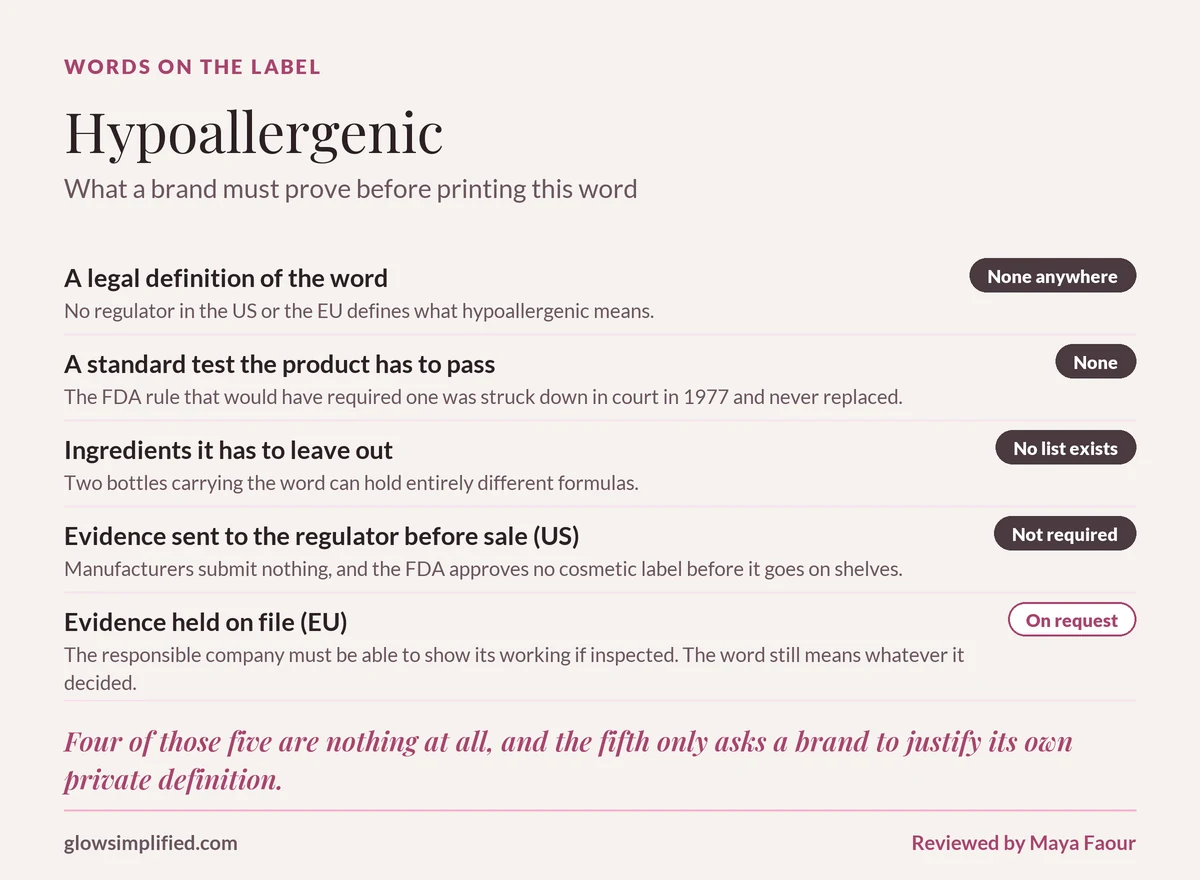
What a brand must prove before printing this word
- A legal definition of the wordNone anywhereNo regulator in the US or the EU defines what hypoallergenic means.
- A standard test the product has to passNoneThe FDA rule that would have required one was struck down in court in 1977 and never replaced.
- Ingredients it has to leave outNo list existsTwo bottles carrying the word can hold entirely different formulas.
- Evidence sent to the regulator before sale (US)Not requiredManufacturers submit nothing, and the FDA approves no cosmetic label before it goes on shelves.
- Evidence held on file (EU)On requestThe responsible company must be able to show its working if inspected. The word still means whatever it decided.
Four of those five are nothing at all, and the fifth only asks a brand to justify its own private definition.
What the FDA actually says
The US position is unusually blunt for a regulator. There are no federal standards or definitions governing the term, and manufacturers who use it are not required to send the FDA any evidence to back it up. The agency says plainly that the word means whatever a particular company wants it to mean.
It was nearly otherwise. In 1975 the FDA finalised a rule that would have let a product call itself hypoallergenic only if studies on human volunteers showed it caused significantly fewer skin reactions than comparable products without the claim. Two hypoallergenic brands challenged it, and in 1977 the US Court of Appeals struck the rule down. Nothing has replaced it since, so brands may keep using the word with no supporting evidence at all.
That sits inside a wider truth about cosmetic labels: the FDA does not approve them before a product goes on sale, and keeps no list of approved claims. Claims still have to be truthful and not misleading, and advertising falls to the Federal Trade Commission, but nobody is checking the front of the bottle before you pick it up.
And in Europe
European rules are stricter about proof, and just as silent about meaning. Any claim made for a cosmetic sold in the EU has to meet six common criteria: legal compliance, truthfulness, evidential support, honesty, fairness, and letting you make an informed choice. In practice the responsible company must hold adequate and verifiable evidence for the claim in the product information file, and that file can be inspected.
What the rules deliberately do not do is fix the wording. They set no definition of hypoallergenic, so the word still means whatever the brand decided it meant. The difference is that in Europe the brand should at least be able to show its working if asked.
What to look for instead
A word on the front tells you nothing. The ingredient list on the back tells you a great deal, and the ingredients that trouble reactive skin are mostly not the ones doing the treating. Actives like retinol and glycolic acid can sting, but that is dose and you chose them. The ones below come along for the ride: they carry the scent, keep the jar safe, do the cleansing, or thin the formula.
Here are the ones our knowledge base flags for irritation among those jobs. If your skin reacts to things and you cannot say why, this is a sensible place to start reading a label.
| Ingredient | Doing what | Irritation risk |
|---|---|---|
| Denatured AlcoholFast evaporating solvent that dissolves actives and degreases skin but can disrupt barrier and increase irritation at higher levels or frequent use. | solvent | high |
| FragranceUndisclosed mix of fragrance compounds; common source of irritation and allergy, offers sensorial benefit only. | scent | high |
| MethylisothiazolinonePowerful preservative that became a major cause of allergic contact dermatitis when widely used in cosmetics and household products. | preservative | high |
| Sodium Lauryl SulfateAnionic surfactant that cleans very effectively but reliably disrupts barrier and increases irritation making it unsuitable for leave-on or sensitive skin products. | cleansing agent | high |
| Cocamidopropyl BetaineAmphoteric surfactant used in mild shampoos and cleansers that is less irritating than SLS but can cause allergic contact dermatitis in a sensitized minority. | cleansing agent | moderate |
This is not a list of ingredients to fear. Most people use all of these happily. It is a list of the usual suspects when something goes wrong, which is a different thing.
How to test a product against your own skin
Your skin is the only test that matters, and it is one you can run at home. Dermatologists at the American Academy of Dermatology give a simple protocol: pick a quarter-sized spot where the product will not be rubbed or washed off, such as the inner arm or the crook of the elbow, and apply the product there twice a day for seven to ten days. Use the amount you normally would. If you are testing something that gets rinsed off, leave it on for about five minutes, the way you would use it.
If nothing happens in those seven to ten days, go ahead and use it. If your skin goes red, itchy or swollen, wash the product off gently and stop. A cool compress or plain petroleum jelly will settle most of it, and a reaction that will not settle is worth showing to a doctor.
One honest caveat: retinol and the acids can sting a little at first even on skin that gets on with them fine. That is irritation, not allergy, and it usually fades. If you cannot work out which ingredient is causing a reaction, a dermatologist can run a real patch test, which is a medical procedure and a different thing from the home version above.
Questions, answered
Is hypoallergenic regulated?
No. In the United States there are no federal standards or definitions for the term, and companies do not have to submit any evidence for it. In the EU a company must be able to substantiate any claim it makes, but the rules still do not define what hypoallergenic means, so the word itself is not regulated anywhere in the way shoppers assume.
Is hypoallergenic better for sensitive skin?
Sometimes, by accident rather than by rule. Because nothing defines the word, a hypoallergenic product may genuinely leave out fragrance and common sensitisers, or it may not. Reading the ingredient list will tell you which of those you are holding, and the word on the front will not.
What is the difference between hypoallergenic and fragrance-free?
Fragrance-free is a claim about one specific thing: no fragrance was added. It is checkable against the ingredient list. Hypoallergenic is a claim about outcomes, that you are less likely to react, and nothing defines or tests it. Fragrance-free is the more useful word of the two. Be careful with unscented, which can mean a masking fragrance was added to cover the smell of the base.
Can a hypoallergenic product still irritate my skin?
Yes. There is no such thing as a product that cannot cause a reaction, and the FDA says as much. Allergy is personal: an ingredient that thousands of people use without trouble can be the one your skin objects to. Patch test anything new, whatever the front of the bottle says.
Sources
- US Food and Drug Administration, "Hypoallergenic" Cosmetics
- US Food and Drug Administration, Cosmetics Labeling Claims
- Commission Regulation (EU) No 655/2013, common criteria for cosmetic claims
- American Academy of Dermatology, "How to test skin care products"
- Glow Simplified, "How we score": our own method and its limits
Cosmetic rules differ by country, and the wording on a label is written for the market it sells in. General guidance, not medical advice. Here is when to see a dermatologist instead.