Ingredient glossary
Dimethiconol
On your shelf ✓What Dimethiconol does for your skin, who it suits, and what to watch for.
INCI: Dimethiconol
In short: Dimethiconol delivers softening and film forming, suits most skin types, and the evidence behind it is moderate.
- What it does
- Softening, film forming
- Best for
- Most skin types
- Evidence
- Moderate
- How long
- Straight away
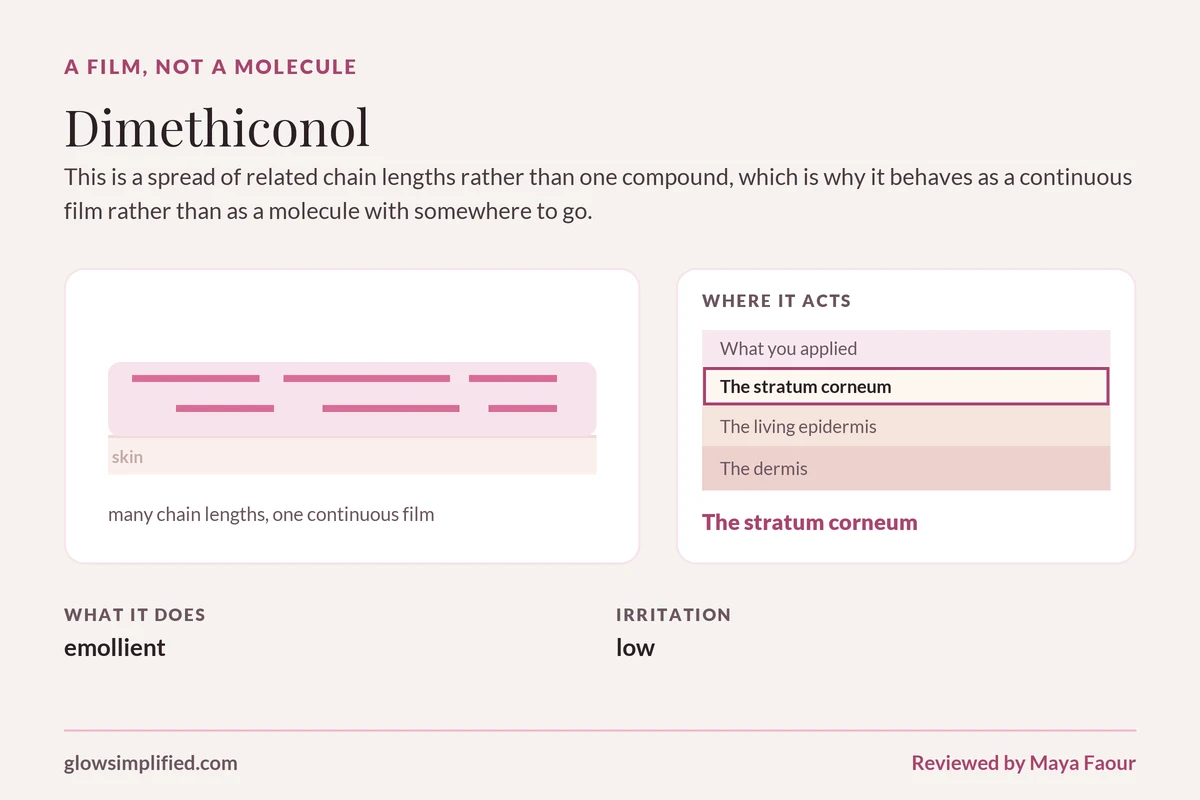
What it actually is
The Glow take
A comfort ingredient, and none the worse for it.
Dimethiconol is here for feel and moisture, softening the skin and slowing water loss. More comfort than correction.
— Maya
What it does
- softening
- film forming
moderate evidenceConsidered non-irritating with good conditioning effects; comedogenicity depends more on overall formula and usage level.
On a label: usually effective at 0.5-5%.
Who it's for, and who should skip it
Tends to suit
- dry
- normal
- combo
Approach with care
- acne prone if heavy
- Clogs poresLow
- Irritation riskLow
How it fits each skin type
- DrySuits
- CombinationSuits
- OilySuits
- SensitiveSuits
Take extra care if any of these apply to you: acne prone (in heavy layers).
Where it fits in your routine
This one works on contact — there is nothing to wait for.
What that covers, and what it does not
Measured on: Surface smoothness from a flexible silicone film, with reduced water loss while the film is intact.
A high molecular weight silicone with terminal hydroxyls, used at 0.5-5% and usually delivered pre-dispersed in a carrier; the film forms as the carrier evaporates and smooths the surface optically and tactilely straight away. Unlike the volatile cyclosiloxanes it stays put, so the smoothing persists until washed off, but it is still a deposit rather than a change in the skin. No human trial reports a timed skin outcome for dimethiconol; most of its performance literature is hair conditioning.
No efficacy-timing trial identified. Ingredient physical chemistry (silicone film former).
Plays well with
- cyclosilicones
- humectants
Dimethiconol, answered
Is Dimethiconol safe during pregnancy?
Yes. Dimethiconol is considered safe to use during pregnancy and breastfeeding. As with anything, if you are unsure it is worth a quick word with your doctor or midwife.
Who should avoid Dimethiconol?
Approach Dimethiconol with care if any of these apply to you: acne prone (in heavy layers).
What concentration of Dimethiconol actually works?
Dimethiconol tends to do its job in the 0.5 to 5% range. Much lower and it is likely underdosed.
This, for every label you own
One ingredient is easy. A full label is where it gets confusing. The Ingredient Decoder reads any product and tells you the honest truth, ingredient by ingredient.